Showing posts with label conversations with patients. Show all posts

Tuesday, May 29, 2007

How I changed, part 2: love and faith


Image: from Harvard Medical School's Countway library: a fifteenth century view of the Antichrist being born by C-section.

* * *

More in how my view of the world has changed since I started medical school, now that I’m graduating:

Before medical school, I used to believe that people were inherently good and that their bad qualities were the product of bad events that happened later. Now I don’t believe that people are inherently anything. Now what I wonder about is whether it is still important to love them.

I understand now that the willingness to try to love everyone in some way is not based on some factual insight about character, but on a large and partly irrational secular leap of faith. For example, when I am feeling nervous about a public speech, one of the things I try in order to summon the best part of myself is to actively think about loving the members of the audience, each one of them. This allows me to try to be my most generous, my most honest, my most enthusiastic. They may not like what I say or how I say it, but if I am in this mood, at least I can be sure that I have given them the gifts I have to offer, as best I can. Loving them is not the same as thinking that they are inherently good (whatever good is), but maybe it involves some faith in their potential for goodness.

At least sometimes, this is how I think I want to be a doctor. And talking about this to Ms Hemodynamics, I said, “I think I need that faith to be a good primary care doctor.”

Ms. Hemodynamics disagrees with this idea. She says that being a good physician means meeting people where they are, whether they’re good or bad; whether they’re good or bad isn’t even part of the question. And she says that she believes that who ever you are, you don’t deserve to suffer, or to be afraid, and that a doctor should believe that; but that a doctor does not need to believe that people are good, and does not need to love them.

I know that she and I both reserve some of our most pointed skepticism about a set of doctors who would at first seem to have much in common with us in their politics and their relationship to the medical-industrial complex. These doctors claim to love people, but actually when you get to know them as clinicians or teachers, you realize that sometimes they love The People more than they love actual people. And one can’t help but think that some portion of them love the idea of being loved by The People more than the idea of actually loving them. The line between The People and actual people is a fine one, but I want to stay on the right side of it: I’m no Ché Guevara, and I’m in no way convinced that The People even exist.

So maybe her approach is the best one: don’t worry about who the people are, or who The People are, and don’t worry about loving them, and definitely don’t worry about being loved by them. Just meet them where they are; figure out what they need; help them get it. When I think about it, this is how I often operate in a day-to-day way.

And yet I think that when I do the best job it is at least sometimes because I have found some kind of love for my patients. This is not always with my most lovable patients. In fact, to persist in trying to do a good job for some of my least loveable patients, I sometimes need to remind myself to try to love them—and that when I do, I often do a better job. This is an active process of trying to summon up some version of Buddhist loving-kindness—again without believing in the larger Buddhist scheme of things. The challenge, I think now, is to love people without becoming attached to the outcome of that love—to not be too upset, for example, when you know a patient is saying one thing to you and actually doing the exact opposite.

“But I love you,” some internal voice of mine has said at a couple of times in medical school with patients I’ve hoped might behave differently, mostly without clear words but just the feeling: “Why are you lying to me and letting me down?”

Given the inevitability of the range of human behavior, including some not entirely palatable kinds of behavior, and the inevitability that some of that behavior will take place in a clinic or in a hospital, it may be too much to ask of myself to love my patients. Or it may not. I’m not sure.

What I think now that is different from before I started medical school is that I don't think that people are inherently good, or inherently anything; I've stopped expecting to be able to find that in everyone. To walk into the clinic expecting something from one’s patients is a sucker’s game, and a sure path to bitterness.

Is unconditional love for my patients the cure for the cynicism that comes from disappointed expectations? Or is it a risk factor for disappointment, and thus, cynicism?

Or, probably most likely, both?

Thursday, May 17, 2007

Testimony: Alberto Gonzales should be kicked out... of the ICU

Apropos of I'm not sure what, except to illustrate the general theme that Alberto Gonzales is an ethics-less toady, Senator Chuck Shumer (D-NY) drew the following story out of former deputy Attorney General James Comey, told below in an excerpt of the transcript from Wednesday May 16 2007.

Let the other blogs chatter about how this hurts or doesn't hurt Gonzales' chance at keeping his job. Here are the questions from the Hemodynamics.blogspot point of view:

Where was hospital security?

And where were the doctors? and John Ashcroft's nurse?

And if you were a resident that month in the ICU, and John Ashcroft were your guy, and you'd been having family meetings with Mrs. Ashcroft, and you knew that Mr. Ashcroft was not the acting attorney general at that moment, what would you do?

Finally, if the president calls the hospital and tells the nurse that Alberto Gonzales is coming and needs to talk to John Ashcroft, but Mrs. Ashcroft is forbidding all calls and does not want Alberto Gonzales to come, what is the legal right and what is the legal obligation of medical staff to stop Gonzales and Card?

Read, and discuss amongst yourselves.

_______________________________

SCHUMER: Before we get to the other issues, I want to go back to an incident from the time that Mr. Gonzales served as White House counsel. There have been media reports describing a dramatic visit by Alberto Gonzales and Chief of Staff Andrew Card to the hospital bed of John Ashcroft in March 2004, after you, as acting attorney general, decided not to authorize a classified program. First, can you confirm that a night-time hospital visit took place?

COMEY: Yes, I can.

SCHUMER: OK. Can you remember the date and the day?

COMEY: Yes, sir, very well. It was Wednesday, March the 10th, 2004.

SCHUMER: And how do you remember that date so well?

COMEY: This was a very memorable period in my life; probably the most difficult time in my entire professional life. And that night was probably the most difficult night of my professional life. So it's not something I'd forget.

SCHUMER: Were you present when Alberto Gonzales visited Attorney General Ashcroft's bedside?

COMEY: Yes.

SCHUMER: And am I correct that the conduct of Mr. Gonzales and Mr. Card on that evening troubled you greatly?

COMEY: Yes.

SCHUMER: OK. Let me go back and take it from the top. You rushed to the hospital that evening. Why?

COMEY: I'm only hesitating because I need to explain why.

SCHUMER: Please. I'll give you all the time you need, sir.

COMEY: I've actually thought quite a bit over the last three years about how I would answer that question if it was ever asked, because I assumed that at some point I would have to testify about it. The one thing I'm not going to do and be very, very careful about is, because this involved a classified program, I'm not going to get anywhere near classified information. I also am very leery of, and will not, reveal the content of advice I gave as a lawyer, the deliberations I engaged in. I think it's very important for the Department of Justice that someone who held my position not do that.

SCHUMER: In terms of privilege.

COMEY: Yes, sir.

SCHUMER: Understood.

COMEY: Subject to that, I -- and I'm uncomfortable talking about this...

SCHUMER: I understand.

COMEY: ... but I'll answer the question. I -- to understand what happened that night, I, kind of, got to back up about a week.

SCHUMER: Please.

COMEY: In the early part of 2004, the Department of Justice was engaged -- the Office of Legal Counsel, under my supervision -- in a reevaluation both factually and legally of a particular classified program. And it was a program that was renewed on a regular basis, and required signature by the attorney general certifying to its legality. [An NSA surveillance program.] And the -- and I remember the precise date. The program had to be renewed by March the 11th, which was a Thursday, of 2004. And we were engaged in a very intensive reevaluation of the matter. And a week before that March 11th deadline, I had a private meeting with the attorney general for an hour, just the two of us, and I laid out for him what we had learned and what our analysis was in this particular matter. And at the end of that hour-long private session, he and I agreed on a course of action. And within hours he was stricken and taken very, very ill...

SCHUMER: (inaudible) You thought something was wrong with how it was being operated or administered or overseen.

COMEY: We had -- yes. We had concerns as to our ability to certify its legality, which was our obligation for the program to be renewed. The attorney general was taken that very afternoon to George Washington Hospital, where he went into intensive care and remained there for over a week. And I became the acting attorney general. And over the next week -- particularly the following week, on Tuesday -- we communicated to the relevant parties at the White House and elsewhere our decision that as acting attorney general I would not certify the program as to its legality and explained our reasoning in detail, which I will not go into here. Nor am I confirming it's any particular program. That was Tuesday that we communicated that.

COMEY: The next day was Wednesday, March the 10th, the night of the hospital incident. And I was headed home at about 8 o'clock that evening, my security detail was driving me. And I remember exactly where I was -- on Constitution Avenue -- and got a call from Attorney General Ashcroft's chief of staff telling me that he had gotten a call...

SCHUMER: What's his name?

COMEY: David Ayers. That he had gotten a call from Mrs. Ashcroft from the hospital. She had banned all visitors and all phone calls. So I hadn't seen him or talked to him because he was very ill. And Mrs. Ashcroft reported that a call had come through, and that as a result of that call Mr. Card and Mr. Gonzales were on their way to the hospital to see Mr. Ashcroft.

SCHUMER: Do you have any idea who that call was from?

COMEY: I have some recollection that the call was from the president himself, but I don't know that for sure. It came from the White House. And it came through and the call was taken in the hospital. So I hung up the phone, immediately called my chief of staff, told him to get as many of my people as possible to the hospital immediately. I hung up, called Director Mueller and -- with whom I'd been discussing this particular matter and had been a great help to me over that week -- and told him what was happening. He said, "I'll meet you at the hospital right now." Told my security detail that I needed to get to George Washington Hospital immediately. They turned on the emergency equipment and drove very quickly to the hospital. I got out of the car and ran up -- literally ran up the stairs with my security detail.

SCHUMER: What was your concern? You were in obviously a huge hurry.

COMEY: I was concerned that, given how ill I knew the attorney general was, that there might be an effort to ask him to overrule me when he was in no condition to do that.

SCHUMER: Right, OK.

COMEY: I was worried about him, frankly. And so I raced to the hospital room, entered. And Mrs. Ashcroft was standing by the hospital bed, Mr. Ashcroft was lying down in the bed, the room was darkened. And I immediately began speaking to him, trying to orient him as to time and place, and try to see if he could focus on what was happening, and it wasn't clear to me that he could. He seemed pretty bad off.

SCHUMER: At that point it was you, Mrs. Ashcroft and the attorney general and maybe medical personnel in the room. No other Justice Department or government officials.

COMEY: Just the three of us at that point. I tried to see if I could help him get oriented. As I said, it wasn't clear that I had succeeded. I went out in the hallway. Spoke to Director Mueller by phone. He was on his way. I handed the phone to the head of the security detail and Director Mueller instructed the FBI agents present not to allow me to be removed from the room under any circumstances. And I went back in the room. I was shortly joined by the head of the Office of Legal Counsel assistant attorney general, Jack Goldsmith, and a senior staffer of mine who had worked on this matter, an associate deputy attorney general. So the three of us Justice Department people went in the room. I sat down...

SCHUMER: Just give us the names of the two other people.

COMEY: Jack Goldsmith, who was the assistant attorney general, and Patrick Philbin, who was associate deputy attorney general. I sat down in an armchair by the head of the attorney general's bed. The two other Justice Department people stood behind me. And Mrs. Ashcroft stood by the bed holding her husband's arm. And we waited. And it was only a matter of minutes that the door opened and in walked Mr. Gonzales, carrying an envelope, and Mr. Card. They came over and stood by the bed. They greeted the attorney general very briefly. And then Mr. Gonzales began to discuss why they were there -- to seek his approval for a matter, and explained what the matter was -- which I will not do. And Attorney General Ashcroft then stunned me. He lifted his head off the pillow and in very strong terms expressed his view of the matter, rich in both substance and fact, which stunned me -- drawn from the hour-long meeting we'd had a week earlier -- and in very strong terms expressed himself, and then laid his head back down on the pillow, seemed spent, and said to them, "But that doesn't matter, because I'm not the attorney general."

SCHUMER: But he expressed his reluctance or he would not sign the statement that they -- give the authorization that they had asked, is that right?

COMEY: Yes.

And as he laid back down, he said, "But that doesn't matter, because I'm not the attorney general. There is the attorney general," and he pointed to me, and I was just to his left. The two men did not acknowledge me. They turned and walked from the room. And within just a few moments after that, Director Mueller arrived. I told him quickly what had happened. He had a brief -- a memorable brief exchange with the attorney general and then we went outside in the hallway.

SCHUMER: OK. Now, just a few more points on that meeting. First, am I correct that it was Mr. Gonzales who did just about all of the talking, Mr. Card said very little?

COMEY: Yes, sir.

SCHUMER: OK. And they made it clear that there was in this envelope an authorization that they hoped Mr. Ashcroft -- Attorney General Ashcroft would sign.

COMEY: In substance. I don't know exactly the words, but it was clear that's what the envelope was.

SCHUMER: And the attorney general was -- what was his condition? I mean, he had -- as I understand it, he had pancreatitis. He was very, very ill; in critical condition, in fact.

COMEY: He was very ill. I don't know how the doctors graded his condition. This was -- this would have been his sixth day in intensive care. And as I said, I was shocked when I walked in the room and very concerned as I tried to get him to focus.

SCHUMER: Right. OK. Let's continue. What happened after Mr. Gonzales and Card left? Did you have any contact with them in the next little while?

COMEY: While I was talking to Director Mueller, an agent came up to us and said that I had an urgent call in the command center, which was right next door. They had Attorney General Ashcroft in a hallway by himself and there was an empty room next door that was the command center. And he said it was Mr. Card wanting to speak to me.

COMEY: I took the call. And Mr. Card was very upset and demanded that I come to the White House immediately. I responded that, after the conduct I had just witnessed, I would not meet with him without a witness present. He replied, "What conduct? We were just there to wish him well." And I said again, "After what I just witnessed, I will not meet with you without a witness. And I intend that witness to be the solicitor general of the United States."

SCHUMER: That would be Mr. Olson.

COMEY: Yes, sir. Ted Olson. "Until I can connect with Mr. Olson, I'm not going to meet with you." He asked whether I was refusing to come to the White House. I said, "No, sir, I'm not. I'll be there. I need to go back to the Department of Justice first." And then I reached out through the command center for Mr. Olson, who was at a dinner party. And Mr. Olson and the other leadership of the Department of Justice immediately went to the department, where we sat down together in a conference room and talked about what we were going to do. And about 11 o'clock that night -- this evening had started at about 8 o'clock, when I was on my way home. At 11 o'clock that night, Mr. Olson and I went to the White House together.

SCHUMER: Just before you get there, you told Mr. Card that you were very troubled by the conduct from the White House room (ph), and that's why you wanted Mr. Olson to accompany you. Without giving any of the details -- which we totally respect in terms of substance -- just tell me why. What did you tell him that so upset you? Or if you didn't tell him just tell us.

COMEY: I was very upset. I was angry. I thought I just witnessed an effort to take advantage of a very sick man, who did not have the powers of the attorney general because they had been transferred to me. I thought he had conducted himself, and I said to the attorney general, in a way that demonstrated a strength I had never seen before. But still I thought it was improper. And it was for that reason that I thought there ought to be somebody with me if I'm going to meet with Mr. Card.

SCHUMER: Can you tell us a little bit about the discussion at the Justice Department when all of you convened? I guess it was that night.

COMEY: I don't think it's appropriate for me to go into the substance of it. We discussed what to do. I recall the associate attorney general being there, the solicitor general, the assistant attorney general in charge of the Office of Legal Counsel, senior staff from the attorney general, senior staff of mine. And we just -- I don't want to reveal the substances of those...

SCHUMER: I don't want you to reveal the substance. They all thought what you did -- what you were doing was the right thing, I presume.

COMEY: I presume. I didn't ask people. But I felt like we were a team, we all understood what was going on, and we were trying to do what was best for the country and the Department of Justice. But it was a very hard night.

SCHUMER: OK. And then did you meet with Mr. Card?

COMEY: I did. I went with Mr. Olson driving -- my security detail drove us to the White House. We went into the West Wing. Mr. Card would not allow Mr. Olson to enter his office. He asked Mr. Olson to please sit outside in his sitting area. I relented and went in to meet with Mr. Card alone. We met, had a discussion, which was much more -- much calmer than the discussion on the telephone. After -- I don't remember how long, 10 or 15 minutes -- Mr. Gonzales arrived and brought Mr. Olson into the room. And the four of us had a discussion.


...

SCHUMER: Let me ask you this: So in sum, it was your belief that Mr. Gonzales and Mr. Card were trying to take advantage of an ill and maybe disoriented man to try and get him to do something that many, at least in the Justice Department, thought was against the law? Was that a correct summation?

COMEY: I was concerned that this was an effort to do an end-run around the acting attorney general and to get a very sick man to approve something that the Department of Justice had already concluded -- the department as a whole -- was unable to be certified as to its legality. And that was my concern.

SCHUMER: OK. And you also believe -- and you had later conversations with Attorney General Ashcroft when he recuperated, and he backed your view?

COMEY: Yes, sir.

SCHUMER: Did you ever ask him explicitly if he would have resigned had it come to that?

COMEY: No.

SCHUMER: OK. But he backed your view over that what was being done, or what was attempting to being done, going around what you had recommended, was wrong, against the law?

COMEY: Yes. And I already knew his view from the hour we had spent together going over it in great detail a week before the hospital incident.


...

SCHUMER: OK. Well, let me just say this, and then I'll call on Senator Specter who can have as much time as he thinks is appropriate. The story is a shocking one. It makes you almost gulp. And I just want to say, speaking for myself, I appreciate your integrity and fidelity to rule of law. And I also appreciate Attorney General Ashcroft's fidelity to the rule of law as well, as well as the men and women who worked with you and stuck by you in this. When we have a situation where the laws of this country -- the rules of law of this country are not respected because somebody thinks there's a higher goal, we run askew of the very purpose of what democracy and rule of law are about. And this -- again, this story makes me gulp.

Friday, May 11, 2007

Cat whisperer


YouTube, aka, HundredsofThousandsOfMoviesOfPeoplesCats.com, has this video which more or less illustrates the content of my conversations with the Hemodynamic Cat, except this guy has two.

Ms Hemodynamics is off on vacation with her mom, so I am staying in the Hemodynamics HQ with the Hemodynamic Cat. The Hemodynamic Cat is a Siamese cat, and like many others who share her ancestry, she has a strong personality. She also seems to have strong opinions which she expresses quite forcefully with sometimes unstoppable loud meowing.

The meow-screeds are sometimes especially unrelenting when Ms Hemodynamics is away. She was Ms Hemodynamics' cat before I came into the picture, and initially waged an incredibly stealthy and devastating terrorist campaign against me to try to stop me from dislodging her from her place as Ms Hemodynamics' BFF. We get along very nicely now that she realizes that even if I dislodged her from her pillow, I would never dislodge her from Ms Hemodynamics' heart. Still, I think she is just slightly more uncomfortable with me, so that she can not decide whether she wants me to reassure her in Ms Hemodynamics' absence, or whether she just wants Ms Hemodynamics to return now and wants to express her opinion about this, or whether she would prefer that I leave her alone to think about Ms Hemodynamics on her own.

This can sometimes become upsetting. When I can not seem to satisfy the gnawing discontent in the Hemodynamic Cat's soul, and she keeps yelling despite my best efforts, I sometimes wonder about the wisdom of becoming a father. (Her meowing can become intensely distressing, and seems to have evolved to resemble the cry of a human baby. It takes real determination to ignore it.)

There are a few tactics which work, but I've recently discovered one that works the best, but is kind of distressing. And it reminds me of a nasty doctor trick.

When cats are content, they make a big long blink of the eyes. And for cats, this signal is contagious, like a yawn, and it seems to be strongly communicative. At some point in the last two days I started doing this to the HC when she was on a tear of yelling. And most of the time she has this reaction:
1. Looks at me insistently, and meows one or two more times loudly.
2. As I continue slowly blinking, she sits and looks down at the floor in a kind of gesture of disappointment, like when we leave the apartment and she realizes that we are leaving.
3. Meows a few more times, but with a quieter, sadder, hoarser tone.
4. Gives up and walks away.

In other words, I think I've figured out how to communicate in cat terms: "I'm content. What's your problem?"

Which, really, is not very nice. It's like when people come in to a doctor's office all freaked out and worried and the doctor says, "I'm not worried at all. You are 100% healthy." And then won't elaborate.

I started feeling a little bad, and now I resolved that there have to be many repetitions of "pick cat up, cat purrs, cat wriggles out of my arms, cat walks around the house, cat comes back and starts yelling again" before I try this tactic. After all, since she's yelling, I'm not at all content. And it's not nice to lie--especially to cats.

Saturday, April 14, 2007

Patient-doctor relationships during possible viral outbreak associated with toxic-waste-created-river-monster

I've kept a clip from The Host (Gwoemul) at the top of this blog (and I'll put it back into this post once this post is archived), because it's the best three-way battle of US-military-toxic-waste-created-river-monster vs. Centers for Disease Control vs. ramen-stand-owning-family-on-the-run that you'll see this year.

Or any year.

It's definitely not going to be even 50% as good on DVD, so go see it before it leaves the theater.

Buy popcorn.

And since the clip kept playing whether you wanted it to or not, I've removed it for now... you can get clips and previews at the movie's web site.

Tuesday, April 10, 2007

What's a doctor? (When in doubt, return to Oliver Sacks.)


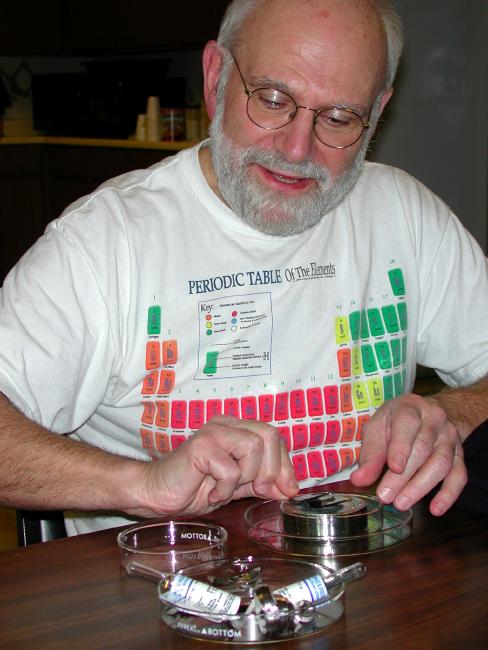
[Picture from the website of Theodore Gray, who had what looks like a great day with Oliver Sacks.]

Is a doctor a consultant, giving her patients advice about how to select medical interventions (or avoid them) based on her understanding of her patient's values? Or is she something else--something more complicated, and emotional?

I was thinking about this after part of a small discussion/debate with one of my favorite teachers, someone who makes it a big part of her job to be extremely thoughtful about the doctor-patient relationship. In my thesis (which I defended yesterday), I cited Robert Rimer, a person with AIDS who wrote a book called "HIV+: Working The System" in 1993, who describes a doctor as being a consultant to the patient; she was responding to this theme with both agreement and skepticism.

But I was thinking about the conversation later in part because I misunderstood part of one of the questions my teacher was asking in our conversation. In retrospect, I think she was arguing that part of what a doctor is supposed to do is care, not just in the sense of providing medical care, but also building an emotional connection and a sense of emotional investment that both the doctor and the patient feel. I agree that this is an important–and extremely rewarding–part of the doctor's job. But when she said, "You describe this as a very intellectual kind of relationship" I agreed with that too.

I'd like to think that part of how I care for people is to be their expert, to be the dork that works for them, their personal geek. And I'm skeptical about the people who dwell too much on the theme of "humanism in medicine", which I think more often than not is just the latest medical buzz phrase for common decency–and yet another chance to pat ourselves on the back. I think doctors are supposed to be decent human beings who treat their patients with respect and concern, but I don't think that's any special calling or anything unique to medicine. I think it's a basic rule of human interaction in an egalitarian society.

Of course, when we are talking with our doctors about really serious parts of our lives, we need to believe that they care about the content of our conversation. And I admit that there is a unique kind of vulnerability that we have with our doctors. Often we are talking with doctors about our own physical frailty, our mortality, and the private intimacies of bodily sensations, bad smells, and objectionable substances. These are things we go to great lengths to hide under all other circumstances.

And so there is also a special emotional obligation on doctors to honor and attend to that vulnerability. And it's true that this is where the "consultant" metaphor begins to break down a little. This vulnerability, not to mention social class, social convention, and even the architecture of the exam room, all conspire to create a real power difference between patient and doctor that is not quite like a classic consulting relationship.

This is not some corporate CEO calling in some Harvard kid who works for McKinsey, to ask how to improve web site traffic.

The emotional currents that run between doctor and patient make a kind of live wire. Those currents can be exploited on both ends. Doctors get a lot of training (especially informal training, which often reinforces some bad values) on how to prevent getting used and manipulated by people who are walking into the clinic or the hospital with a set of agendas that doctors don't want to serve. Psychiatrists spend a lot of time talking to each other about monitoring their own emotions during sessions as a way of using their own emotional state as a kind of sensor to help them understand what the patient is going through. For instance, if psychiatrists start to feel agitated and confused during a visit, if they can stand back from that sensation for a moment they can recognize what it is about the patient (usually agitation and confusion) that is triggering this feeling.

But most patients walk in without that kind of tool. When the electricity of powerful emotions begins in the exam room, they're caught without gloves on. This sometimes clouds people's thinking and makes it difficult to contrast their own agendas with the doctor's agenda. When this happens, it's not until later, when they've left the exam room and gone home, and the electrical current fades and then shuts off, that they realize that they wanted something different from this visit than the doctor did. In other words, I think sometimes people can sink into the emotional connection they get from the clinic–which can be powerful–and lose the ability to clearly and precisely advocate for themselves.

So when I talk about being a consultant, it is not with the aim of eliminating emotion from the exam room, nor with the aim of failing to care for the patient. But that care has to give some breathing room; it can't be enveloping, or it will suffocate the patient's own power and initiative, or constrain its birth and growth.

Anatole Broyard wrote:
"My ideal doctor would be my Virgil, leading me through my purgatory or inferno, pointing out the sights as we go. He would resemble Oliver Sacks, the neurologist who wrote Awakenings and The Man Who Mistook His Wife for a Hat. I can imagine Dr. Sacks entering my condition, looking around at it from the inside like a benevolent landlord with a tenant, trying to see how he could make the premises more livable for me. He would see the genius of my illness. He would mingle his daemon with mine: we would wrestle with my fate together."

This is a complicated, even jumbled, set of metaphors. But the ideas are useful, and not just because they're about Oliver Sacks. Broyard describes the doctor first as a guide; and then, as a kind of owner of one's own condition, a guide who can not only show you around but help improve the premises.

In this way of describing the doctor, the doctor is important because of his expertise; but also because he employs that expertise with kindness. It's important here to note that Oliver Sacks as a man is actually frankly odd, or so it seems from his lovely book Oaxaca Journal. In the book he takes a tour of Oaxaca with a group of fern aficionados; he is also a quite dedicated fern aficionado. He often sets himself apart from the group, most of whom are paired off in couples. He is clearly the nerd, and the striking thing about this, of course, is that he is the nerd among a group of people who have devoted a considerable amount of their free time to thinking about ferns.

Nonetheless, after a while, he begins to become engaged in some mild running jokes with a couple of his fellow travelers, and to build relationships in a way that seems totally ordinary to me as a reader. (He seems to be thrilled by one of his dorky running jokes, even perhaps by the very idea of a running joke. I have this kind of running joke with various people in my world all the time, as do most of you, dear readers.) And yet by the end of his trip he feels completely happy in a way that he rarely has before.

He writes:

"I myself may be the only single person here, but I have been single, a singleton, all my life. Yet here this does not matter in the least, either. I have a strong feeling of being one of the group, of belonging, of communal affection–a feeling that is extremely rare in my life, and may be in part a cause of a strange "symptom" that I have had, an odd feeling in the last day or so, which I was hard put to diagnose, and first ascribed to the altitude. It was, I suddenly realized, a feeling of joy, a feeling so unusual I was slow to recognize it. There are many causes for this joyousness, I suspect–the plants, the ruins, the people of Oaxaca–but the sense of this sweet community, belonging, is surely a part of it."


I believe, reading Oliver Sacks, that he must be a good doctor. Clearly Anatole Broyard believed the same thing. And yet if we are to believe his journal it seems to take him completely by surprise to feel a sense of belonging among other human beings, and that only transiently. How can this be if the essence of being a good doctor is human connection?

There are a couple of possible answers. One is that Oliver Sacks is a wonderful writer but a lousy doctor. It's hard to know if this is true, but even harder to believe. Another is that Oliver Sacks feels as if he is not making human connections even when he is. This seems more likely.

Most of all, Oaxaca Journal made me think that Oliver Sacks has a sense of solidarity with his patients in the neurology clinic, in the sense that he is acutely and intuitively aware of the idea of neurodiversity. However it is that his brain works, he is quite aware that it is not like other peoples' brains. And when Temple Grandin described herself as "an anthropologist on Mars", and he titled his book of essays with this phrase, it's hard not to wonder whether Sacks himself does not feel sometimes like an anthropologist on Mars, albeit a very kind and enthusiastic anthropologist.

But we know for sure that Oliver Sacks is driven by fascination, by intellectual interest in people and how they think and how they perceive the world. He is able to be fascinated in a kind way, and his fascination is infused by solidarity. And this is what is moving and wonderful about his writing. I think this is also what probably makes him a good doctor, and a good consultant.

He is not taking you out of hell, though if he can walk you towards the door out, he will. He is showing you around, and explaining what is going on there, and working with you to see if things can be better if this turns out to be where you are going to have to live. Anatole Broyard and I read Oliver Sacks and see this in him, and we think that this seems like what a doctor is supposed to be.

I hope to do the same for my patients: to be kindly fascinated, to feel a sense of solidarity with them, and help show them around. Is this caring? Sort of; in fact, it can even feel like a kind of love. But not exactly. It is not a parental or even a fraternal kind of love; it is not even friendship, really.

When we are ill, and live in fogs of pain or nausea or fear of death, it is the people who love us who should love us, and hold us, and remind us of what is good about the fact that we lived on this world and breathed its air. Doctors can do this in a pinch; but so too can many other people. Most people think their nurses are actually better at it.

So what's the point of a doctor? What's the doctor supposed to be? The answer is somewhere in this area of metaphors, of consultants and guides. The point of the doctor is to illuminate the inner landscape and history of our own bodies, to show us around when it becomes confusing, to suggest a way out when we get lost, or a way to get comfortable if we are trapped.

If I did not believe deeply in the value of that expertise, and if I only wanted to be kind and concretely useful to people who were suffering, I would have been a nurse, or perhaps a hospice volunteer. I actually spent a lot of time thinking about this choice, and it was not an easy one for me. But to become a doctor, I needed to accept the idea that I am not first a carer. I am a guide, who cares.

Friday, March 30, 2007

A guy wrote a poem

Donald Hall wrote a poem called "The Ship Pounding" about his wife in a hospital, getting chemotherapy. He talks about how he thinks they are traveling somewhere – that the chemo will get them both home. But as he returns to the hospital with her a little bit later, now with her delirious, and presumably still more sick, he sees the hospital as a ship forever in port, without destination, its massive engines churning as the ship stays still.

I was on a pain and palliative care rotation at the hospital where I suspect that he wrote this poem, and a patient was saying something – which, I have to be honest, I now forget. (Does this make the story better or worse? I'm not sure.) I remember that I said, "There was a guy whose wife was here for cancer treatment in this hospital, and he wrote a poem where he described the hospital as a ship with its engines going all the time but always staying in port." The patient said, "Not going anywhere." And I said, "Right." And the patient gave a little smile in recognition.

I think I marked the moment in my memory not for the rest of the conversation but because I was amused at the way I blurted out my literary reference, as soon as I had done it. Was I going to tell this patient that I was referring to a poem that a literature-minded teacher had passed around to a medical school class, or tell him I was referring to a poem written by one of America's premier poets? (Not to mention that the poem was also partly about one of America's premier poets, Jane Kenyon, who was the one with the leukemia and then the delirium.) No. Somehow it was intuitively important to me that I describe it just as a poem by a guy who'd been in this hospital, as casually as I could, as if he'd written it down on a piece of paper and someone at the nurse's station had xeroxed it, and a nurse posted it up in the break room, and a resident passed it around on rounds with everyone nodding and saying, "Wow, that's cool. That's a really good poem."

Although this is not how the poem found its way to me, it seemed useful to imply that it had. By acting like it was just this poem that the nurses had been handing around, I think I hoped to convey that I was just connecting the experience of one inhabitant of this hospital to another. Perhaps this was my barely conscious effort to play an old role, based on the idea that the doctor should exist only in the social role of doctor. The doctor lives not as the person who goes home and reads a book of poems, but only as one of the crew, on the ship, tending to the churning, pounding engines.