Showing posts with label medical school. Show all posts

Sunday, July 15, 2007

Becoming a doctor requires imagining the obvious.

When I was in medical school, I worked hard; I was thoughtful about my patients; I got along well with most of the people I worked with. But my grades weren't as good as some of my colleagues' grades were. They were fine, but more often than I liked, I seemed to just miss the highest grade in my overall evaluations. Sometimes that was for blatantly unfair reasons, other times for reasons I understood perfectly. But most of the time, it was harder to tell why I'd just missed. I spent a lot of time thinking about how to improve, and asking people how I should be improving.

In the last part of medical school I was starting to get it. An ICU rotation gave me the biggest transition: I went from doing some of my worst clinical work (in that I was disorganized and confused in presentations and in my thinking about patients) to some of my best. A couple of other rotations towards the end of medical school also went well. Still, I wasn't sure exactly what had changed, and which of the things I'd done to try to improve had actually worked.

Now that I'm an intern, I still have a lot to learn. And I'm sure I'll still have many stumbles and falls ahead. But I feel more confident in a way that surprises me, but also explains a lot of my medical school experience. I recently realized that it took me until some point between getting my diploma and my 20th hour of internship to actually believe that I was going to be a doctor. In other words, until I became a doctor, there was some part of me that didn't understand that I was actually going to be one.

In fact, even during my first day on call the meaning of the job still hadn't 100% sunk in. I was just trying to keep up, to not do anything wrong, to keep my feet on the floor and my pulse within normal limits. Before I started, everyone told me to listen to the nurses, and especially with a bunch of ICU veterans like the nurses working with me, that seemed like great advice. Nurses were coming up to me and saying, "Mr T's pressure is dropping; I think we should give him a bolus of fluids." Great, I'd say. "Half a liter sound good to you?" I'd say, entering the order into the computer. "Mrs S's potassium is down," another would tell me; "Thanks, I'll order that now," I'd say, looking at the sliding scale to replete the potassium.

For most of that first day on call, this worked excellently. Our hospital's critical care nurses are excellent, my resident and attending were watching closely, and our patients did well.

At some point early in the morning, a nurse suggested another bolus of fluids on a patient. The patient had already had a fair amount of fluid through the day. I started worrying about what another half a liter was going to do to his lungs. "Actually, I'm hesitant to do that," I said to the nurse, explaining my reasoning. Together the nurse and I talked through an alternative plan, and I checked in with my resident. It was a tiny step, a tiny transformation, but I recognized it: actually, I was a doctor. The MD on my badge was more than some iconic token of my education.

Later, as I realized that I understood some of the physiology and basic science of another one of my patient's problems, and that my patient's nurse did not understand it in the way I understood it, I realized that those years of medical school did teach me something. It's not that her education and experience and observations didn't add up to anything. But it added up to something different. Patients are safer and better-served when nurses tell doctors when their medical interventions will cause unforeseen harm, and when they are partners in the conversation about what might be done next. But that doesn't mean that doctors, even new ones, can get away with just relying on the nurse to keep the patient well.

All of this is pretty obvious to an outsider, and probably to most medical students too. But now I realize that I hadn't ever 100% believed that I would become a doctor. That belief, I see now, is a big part of the intangible confidence that some of my colleagues with better grades had. It's part of how they looked like future doctors instead of current medical students. And when I at least mostly believed that I was responsible for being a doctor--as in my ICU rotation, and a couple of others--I did well.

Now I'm a doctor. And I actually believe it. As soon as I started believing it, I became a better doctor, in an instant.

Now, looking back and recalling that a medical student will, 98-99% of the time, graduate and become a doctor, I've been thinking about what part of me wasn't registering the obvious likelihood that I would also soon become a doctor. Some of the answer comes from who I was before medical school. The people who love me the most have always had great faith in me, and believed that I was capable of many things, but I don't think that when I was in my teens and up to my mid-twenties that anyone who knew me well would have predicted what I'm doing now. I thought of myself as an artistic person, and a political person, but not as a scientific person, nor as a person who would ever become such a normal thing. Willie Nelson instructed, "Mamas don't let your babies grow up to be cowboys"--instead, he sings, "make 'em be doctors and lawyers and such." I never thought I'd be a cowboy, but I didn't think I'd be one of those and-suches either.

Many of my classmates come from medical families. They believed they'd become doctors because the job and the social identity seemed natural to them. They might have resisted it when they were younger, in order to walk their own paths and not their parents', but when they returned to the path of medical training, the terrain was familiar. The medical students who didn't come from medical families often spent their lives, since they were children, working towards the goal of becoming a doctor. I think that many of these classmates, in both categories, always believed in their future as doctors, as soon as they walked into the hospital. They started to become doctors well before they were qualified to earn a medical license. That's actually sensible. You're 66% a doctor at some point in the third year of medical school; at that point you are really more a doctor than not.

When I look back and see the ways I was improving in the last part of medical school, I see that I was becoming a doctor, that the 85% doctor I already had become was directing my actions, even if my consciousness was still too aware of the 15% doctor that I was not.

It seems easier to imagine becoming an excellent and experienced doctor (which, nearly by definition, I am not) than it was to imagine becoming a doctor at all. The next part of my training will require more work, more cognitive strain, and a steeper learning curve than medical school ever asked of me. But in terms of how I see myself, and how I've had to change how I see myself, the hardest part might have just ended.

Friday, June 15, 2007

khakis and button-down


Today at our hospital's ACLS training for incoming interns, the Harvard boys were clustering together a little more than we should have been. (Knowing myself and the others, the clustering was more social anxiety than it was snobbery, but of course that's a fine line.) More remarkably, of seven Harvard Medical chaps who were there, all seven were in some variation of khakis and a button-down, no tie. I think five had blue shirts on, and two had white shirts. (Or was it four and three?) One of our group of Harvard boys was dressed slightly more casually yesterday, but he fell into line today.

No one else among the incoming interns from other schools was dressed exactly this way. Most were a bit more casual. It was a training, and therefore there was no clear dress code. A few were as formal as we were but in different ways: with different kinds of colors, fabrics, and so on.

I didn't dress this way before. I lived in San Francisco and wore jeans to work; when I bleached my hair my workplace credibility as a community organizer went up, not down. My lab boss in Bethesda wore all black clothes (except she wore bright yellow clogs) because she didn't want to be bothered with the problems of matching colors; no dress code there either.

Harvard changed me. Harvard somehow made me think that I should dress this way. And I think we tuned ourselves to each other: we looked more alike the second day of training than we did the first. But clearly, long before this training, without anyone explaining it or demanding it of us, we all became the guys who wear the khakis and the open-collar blue shirts.

"It's what I'd wear if I was coming over here to meet with my research advisor," said A, one of my co-terns. I said, "Of course; me too." On some level, we both felt--well, what else would you wear? In fact, I had semi-consciously run through the differential on both mornings before the training days, looking in my drawers and my closet. I thought about a dark plain polo shirt but it seemed some combination of too casual and too golf-y. Jeans were out of the question. Definitely not a t-shirt. Not even an untucked short-sleeved button-down. I don't own any brightly-colored button-down shirts; if I did I wouldn't have chosen them. Yet other men there made all of these fashion choices, and others like them.

When I told her about all this, Ms. Hemodynamics said, "Well, sure. That's part of why they were recruiting you guys."

"But I find this distressing," I said. "That somehow the institution has taken my aesthetics and eccentricities and ironed them out of me."

She understood this; but she thought my clothes were still the right choice. And of course, my program had been recruiting her too.

Friday, June 8, 2007

"Found Down": HMS/HSDM Commencement speech


"Each of these stories become more subtle and often more difficult versions of the same question: when we see suffering, do we look away, or go towards it?"
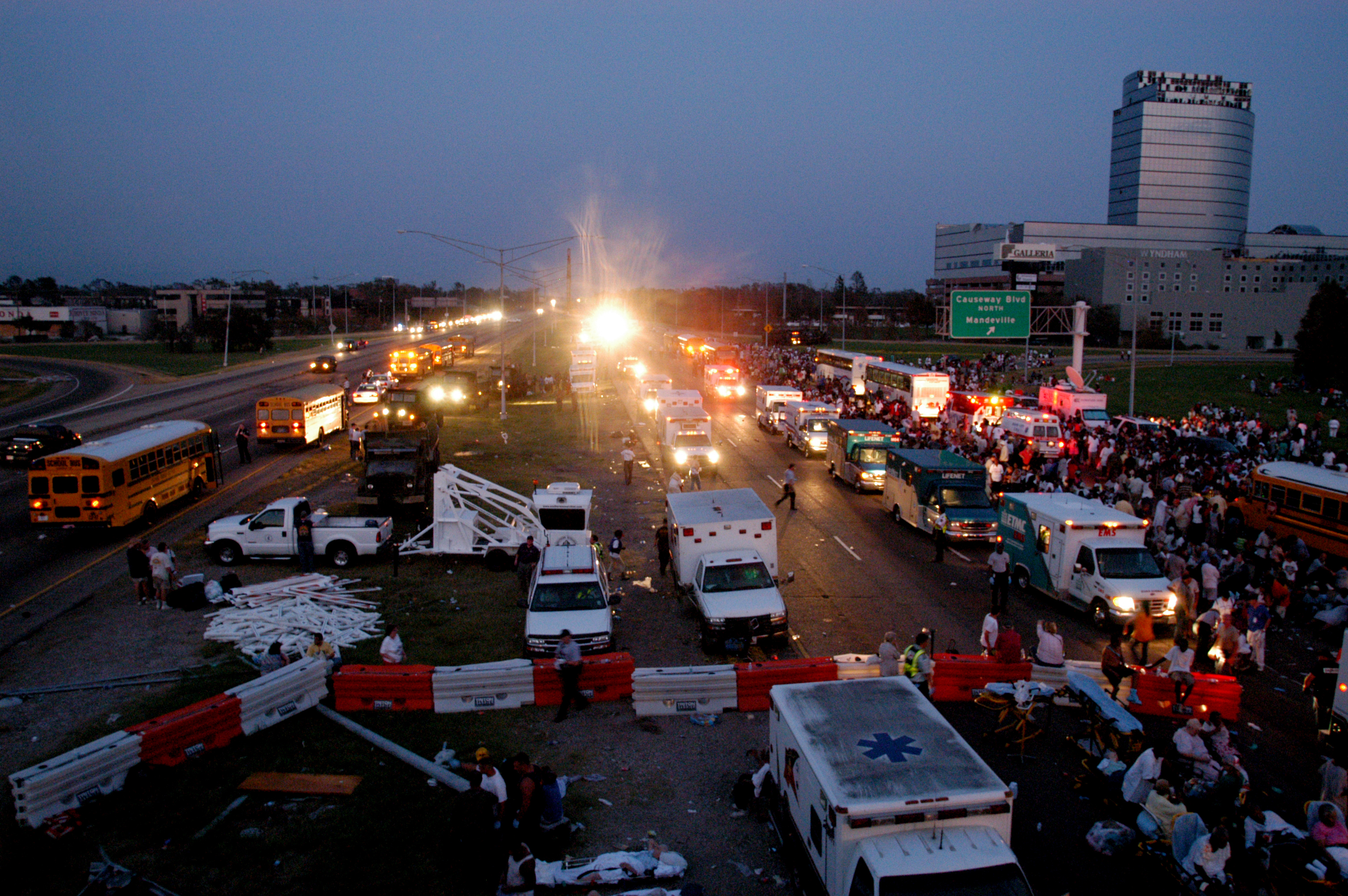
Photo: rescue staging area after Hurricane Katrina.


...More to write about graduation soon (it was yesterday, June 7). First, here's the speech I gave at the commencement ceremony of the Harvard Medical School and Harvard School of Dental Medicine.

I’m going to start with a story. It starts when a man falls down on the sidewalk. He might be drunk, or he might not. He might be unconscious because he fell, or he might have fallen because he became unconscious. Hopefully sooner than later, someone realizes that he has fallen down.

The call to 911 comes from the first person to realize this and to care. Next comes the ambulance crew, and even the cars that get out of the way when the siren goes on. As the story continues, there are triage nurses and doctors, x-ray technicians and respiratory therapists. Maybe the man found down has a strange rash, goes to cardiac cath, or needs a CT scan; maybe he has blood in one of his eyes, or a shattered bone. There will be more to the story, but this is its essence: a person falls, and in small and large ways, a huge network of people begins to pick him up again.

Today, we step into a new role within this network. But we have already been part of this group of people: those who go to the man found down, and try to help him up.

We can’t be too romantic about this story. Almost as soon as the man’s story begins, promises and demands of money start moving through the wires underneath the sidewalk onto which he fell, perhaps even before he has been picked up off of it. But today is not about that part of the story. Today is about what we do because of who we are, and not just who we are paid to be.

Each of us will encounter different versions of this story in our work. A child is frightened of her father. A veteran is overwhelmed with anxiety inside an MRI machine. And a family is just down the hall, waiting to hear the news of an operation, and someone must tell them that the operation went badly. Hundreds and maybe thousands of stories like this are unfolding at this moment, right outside this tent, in the hospital and clinic buildings all around us. And each of these stories become more subtle and often more difficult versions of the same question: when we see suffering, do we look away, or go towards it?

We’ll have to answer this question day after day. I once heard an ICU nurse in an urban hospital say, “All of our patients have the same chief complaint: found down.” July’s novelty and excitement will be followed by February’s bleak repetition. Just about any hospital has many people found down for reasons that are easy to diagnose, but can seem impossible to solve.

To respond to this sometimes relentless suffering, we’ll have to push back against huge impersonal systems, even when those systems beat us back again and again. And we’ll sometimes have to forgive terrible human frailty even as that frailty pushes us to our limits of forgiveness. And so nearly all of us will succumb to frustration and even cynicism from time to time. This is nothing to be ashamed of, as long as we don’t wallow in it, and as long as we don’t mistake bitterness for truth. We are graduating from medical school, not saint school.

Nonetheless, we can hope to meet the basic moral standard of looking towards suffering instead of away from it. In clinics and hospitals, in our personal lives, and in research and policy, we’ll constantly face this moral challenge. Even the best of us will often fail it. But that should not stop us from continuing to try.

When we do reach this standard, we have one final important task: to avoid congratulating ourselves too vigorously for our own forms of benevolence. Sentimentality about our special virtue as doctors can be as dangerous as cynicism, because it causes us to forget that we are joining something much larger.

Our medical training means that we will bring our expertise, our intellectual curiosity, our readiness to work hard. We can be justifiably proud of ourselves for what we have already accomplished, and we know for sure that the people in the audience today are already proud of us.

But today we also join others—paramedics, nurses, social workers—and dentists—and many others who spend their lives responding to suffering. In the few blocks around us, there are thousands of people like this. And even more importantly, there are many other people who are not healthcare workers, but just caring people who also see suffering and find ways to respond. I came to medical school because of people like this—people who responded to the crisis of the AIDS epidemic in San Francisco, people who taught me about courage in the face of disaster.

In small or large ways, most of us have probably come to sit here today partly because of people like this, people who taught us how to behave in the face of suffering: teachers, friends, family. They have usually taught us by example, often because they cared for us when we were suffering. Some of those people are here today. They have seen us fall; in one way or another, they have found us down and helped us up, sometimes many times. As we graduate, we honor their acts of faith in us. Today we mark a moment in which their gifts to us have come to fruition. Now, we will join them in helping those who are found down.

Tuesday, May 29, 2007

How I changed, part 2: love and faith


Image: from Harvard Medical School's Countway library: a fifteenth century view of the Antichrist being born by C-section.

* * *

More in how my view of the world has changed since I started medical school, now that I’m graduating:

Before medical school, I used to believe that people were inherently good and that their bad qualities were the product of bad events that happened later. Now I don’t believe that people are inherently anything. Now what I wonder about is whether it is still important to love them.

I understand now that the willingness to try to love everyone in some way is not based on some factual insight about character, but on a large and partly irrational secular leap of faith. For example, when I am feeling nervous about a public speech, one of the things I try in order to summon the best part of myself is to actively think about loving the members of the audience, each one of them. This allows me to try to be my most generous, my most honest, my most enthusiastic. They may not like what I say or how I say it, but if I am in this mood, at least I can be sure that I have given them the gifts I have to offer, as best I can. Loving them is not the same as thinking that they are inherently good (whatever good is), but maybe it involves some faith in their potential for goodness.

At least sometimes, this is how I think I want to be a doctor. And talking about this to Ms Hemodynamics, I said, “I think I need that faith to be a good primary care doctor.”

Ms. Hemodynamics disagrees with this idea. She says that being a good physician means meeting people where they are, whether they’re good or bad; whether they’re good or bad isn’t even part of the question. And she says that she believes that who ever you are, you don’t deserve to suffer, or to be afraid, and that a doctor should believe that; but that a doctor does not need to believe that people are good, and does not need to love them.

I know that she and I both reserve some of our most pointed skepticism about a set of doctors who would at first seem to have much in common with us in their politics and their relationship to the medical-industrial complex. These doctors claim to love people, but actually when you get to know them as clinicians or teachers, you realize that sometimes they love The People more than they love actual people. And one can’t help but think that some portion of them love the idea of being loved by The People more than the idea of actually loving them. The line between The People and actual people is a fine one, but I want to stay on the right side of it: I’m no Ché Guevara, and I’m in no way convinced that The People even exist.

So maybe her approach is the best one: don’t worry about who the people are, or who The People are, and don’t worry about loving them, and definitely don’t worry about being loved by them. Just meet them where they are; figure out what they need; help them get it. When I think about it, this is how I often operate in a day-to-day way.

And yet I think that when I do the best job it is at least sometimes because I have found some kind of love for my patients. This is not always with my most lovable patients. In fact, to persist in trying to do a good job for some of my least loveable patients, I sometimes need to remind myself to try to love them—and that when I do, I often do a better job. This is an active process of trying to summon up some version of Buddhist loving-kindness—again without believing in the larger Buddhist scheme of things. The challenge, I think now, is to love people without becoming attached to the outcome of that love—to not be too upset, for example, when you know a patient is saying one thing to you and actually doing the exact opposite.

“But I love you,” some internal voice of mine has said at a couple of times in medical school with patients I’ve hoped might behave differently, mostly without clear words but just the feeling: “Why are you lying to me and letting me down?”

Given the inevitability of the range of human behavior, including some not entirely palatable kinds of behavior, and the inevitability that some of that behavior will take place in a clinic or in a hospital, it may be too much to ask of myself to love my patients. Or it may not. I’m not sure.

What I think now that is different from before I started medical school is that I don't think that people are inherently good, or inherently anything; I've stopped expecting to be able to find that in everyone. To walk into the clinic expecting something from one’s patients is a sucker’s game, and a sure path to bitterness.

Is unconditional love for my patients the cure for the cynicism that comes from disappointed expectations? Or is it a risk factor for disappointment, and thus, cynicism?

Or, probably most likely, both?

Thursday, May 24, 2007

How I changed, part 1: life and death


"Any animal’s minute-by-minute life is a constant process—or actually, a system of many interlocked processes. All of us animals are constantly kept alive by our systems of life." Video: the Hemodynamic Cat takes a nap.

“This process must have changed you,” my friend R said, as we were talking about my upcoming graduation from medical school. “But how did it change you?”

I’ve been thinking about that ever since, and I’ll be thinking about it more—this surely won’t be the last that I write about it.

* * *

Life and death changed around me even in pre-medical biology classes, but much more acutely as a medical student. Walking along a crowded beach, or out in nature, or even sometimes in the city, I much more frequently and knowledgeably remind myself of the physiology of the life around me. There are the big bipedal apes (you know, us); the birds; the dogs; the fish in the sea. When I see a dog running down the beach, or children splashing in the waves, or a row of birds flying in formation, I am much more likely now to remember how they are able to do these things. Their hearts are beating, their lungs are taking in oxygen, the mitochondria of their cells are using the oxygen for biochemical reactions which allow them to store energy, and the cells of the brain are using that energy to direct the activity of the rest of the body.

Any animal’s minute-by-minute life is a constant process—or actually, a system of many interlocked processes. All of us animals are constantly kept alive by our systems of life. Those systems are so complex that even after a lifetime of me learning about the biology of people alone (never mind birds, or dogs, or fish), I will die having learned only about a fraction of the cells and molecules and organs that will have kept me alive until that moment.

And if any of it stopped for any of the animals around me, the whole scene would change. A bird would fall into the water. A man would fall down on the beach. A dog would stop moving. The change from my previous life is that I more frequently remember that these underlying processes must constantly be working to allow the life around me to keep living. I more reliably remember some basic information about how these processes work. And so I more often appreciate that their workings all around me—the panting of the dog, the shouting of the children, the bird using its muscles to flap its wings—are each made possible by still more mechanisms. I more frequently notice and love the baroque and beautiful details of life.

* * *

I came to understand emotionally—and not just intellectually—that life is not the default. In fact, life is an improbable and incredible struggle made possible only by a constant cooperative struggle of cells working against the processes of entropy. Death no longer surprises me, though it still can upset me.

I first began to understand my own mortality at around the time a lot of people do, in my early twenties. But my understanding began in the midst of the HIV epidemic. Before medical school, I devoted a great deal of my work life and much of my volunteer civic energy to the cause of preventing new HIV infections. And partly because my consciousness of death came from HIV in the early 1990s, I was always conscious of the possibility of death, but I was always engaged in the effort to prevent it.

A few years after I started doing HIV prevention work, a high school friend of mine was diagnosed with metastatic cancer. I was not much involved in her care, and although we stayed friendly throughout, her social world contracted to a small circle in which I was not usually included. The one thing that my partner of the time and I were able to do to help was to find her and her boyfriend an apartment in San Francisco, which at the time was no small feat. The apartment was immediately below us, so although I did not see her socially very often, I saw her through windows or during comings and goings, and saw her getting more and more skinny and weak. I saw her boyfriend going through many stages of worry and grief. I knew when she died.

Though I knew intellectually that it shouldn’t, emotionally her diagnosis and death surprised me. My friend seemed like a buckle-the-seatbelts, wear-your-condoms sort of person; she won lots of the good student awards in high school. My surprise and shock about her death helped me see that my public health work had an irrational emotional abscess festering within it: the hope that somehow everyone could be saved from death if we all just behaved ourselves. Looking back, I think that her death was one part of my trajectory towards medicine. It helped me towards the very beginning of realizing emotionally and viscerally that death and suffering is a part of life--and not just the product of a particular epidemic that had to be stopped.

When I got to medical school, death gradually became much more a part of my regular experience. Two different anatomy classes (the required one and an optional one) meant that I dissected two different bodies. This required a very lengthy and detailed involvement with the bodies. And that meant a close-up constant literal immersion in the fact of death.

Then there were my patients, many of whom were dying, facing life-threatening diagnoses, or fearing the possibility of death; and some of whom died. I actually gravitated towards some of this in medical school. I took more oncology-related rotations than most people do, and I did an ICU rotation. Before death, there were worries; struggles with families and within families; various forms of physical suffering, and even more forms of emotional suffering. Death started to seem like the simple part. Living near death is much more difficult and complicated.

From being immersed in the bodies of my two anatomical donors, and then also from physical exams, Pap smears, stitching up wounds and draining abscesses, and standing next to surgeons in the OR trying to make myself useful, I got the immediate and now deeply-remembered sense of the physicality of our bodies. Before medical school, I was moved and fascinated by the fact that we were only frail physical bodies. I once wrote a kind of prose poem about it, which I must have in an old notebook somewhere. But I did not regularly make the emotional leap from my intellectual or poetic understanding of this frailty. That emotional leap required learning biology. It required knowing in detail the ways in which we are physical beings. Knowing these details convinced not only my intellect but my emotions that our physical selves must eventually cease to exist.

I am not a religious person: I believe that who we are is contained by our physical selves. Biology is the beginning and end of life, and it is life itself. We live because our cells work. We die because of the built-in limits of our cells and the systems they make. Even those limits are part of our biology.

It shouldn’t be a surprise to me that going to medical school helped me understand life and death in a different way. But I think I hoped when I started that the understanding would come as a mystical or philosophical insight, or some spiritual catharsis on a call night. That’s not what happened. Instead, I learned biology, and learned more biology, and then I started seeing life as biology, and biology as life.

How we feel about all of this, and what we say to each other about it, is important; but how we feel and what we say is also part of the beautiful biology of long-lived social animals. We are bipedal apes; we use tools and language; our hearts beat. Like pelicans and elephants, we are born, we live together, and then we die.

Photo: based on their behaviors, it seems reasonable to believe that elephants mourn the dead.

Thursday, May 10, 2007

A glass ceiling in academic medicine?

Rosie the Riveters of academic medicine: the first women admitted to Harvard Medical School, in 1944. Women limited to 5-10% of the class for decades thereafter. From the Countway Library, HMS.

Medical academic extraordinaire Orah Platt putting a white coat on med student Tara Benjamin in 2001. Women are becoming a majority of entering medical students, but it's not yet clear how quickly the highest ranks of academic medicine will catch up with the lowest. From HMS's Focus newsletter.

Boston.com's "White Coat Notes" has a brief article about recent adding-up-the-basic-numbers findings, showing a lack of women in leadership positions in medical schools in Boston. A man who has been one of those looking into the problem says, "People might reflexively think that it's discrimination or a glass ceiling, and there may well be an element of that."

Right. There may well be.

Then he says, "It may be in some cases that women choose not even to apply for these positions or don't aspire to them because they are not appealing to women at that stage in life."

So, let's take the second proposition as true, for the sake of argument. Let's say that the medical schools have designed a set of powerful positions that they realize may not be appealing to women. That IS discrimination and a glass ceiling. It's discrimination against women the same way a set of stairs without a ramp is discrimination against wheelchair users. It's a way of saying we don't want you here, we don't want to find a way of getting you to come here, and in fact, we can't even imagine you being here--without actually having to say it to anyone's face.

For my part, I don't think there's really much functional difference between that kind of discrimination and the kind of discrimination that happens when some department chair just plain hates women in some kind of more personal and visceral way.

Saturday, April 7, 2007

Honor.


My classmates have given me a really great honor... I'll be one of two medical student speakers at our graduation.

Each year, there are two medical student speakers. In general, one is humorous and the other is painfully sincere. Because I had to write my speech in order to audition for my classmates, I can already tell you that I'll be taking the painfully sincere spot in the batting order.