Showing posts with label GLBT. Show all posts

Sunday, December 6, 2009

Buy for the Borum

Paul Levy, the Beth Israel Deaconess Medical Center's CEO, is using his blog to publicize online auctions to support community health centers affiliated with the BIDMC. Right now there's an auction to support the Sidney Borum, Jr, Health Center. The Borum is dear to my heart, so let me take this moment to ask you to consider buying something... much of which remains at a considerable discount. (For instance, tickets to the Messiah at a fraction of their face value, which is how everyone likes their messiahs.)

Thursday, November 13, 2008

Hank Wilson, whistle-blower.


I wrote a while ago about the "No Obits" moment in the Bay Area Reporter.

Today I read a BAR obituary that made me pretty sad. Veteran activist Hank Wilson has died.

Here's Liz Highleyman's nicely-written obituary in the BAR; I'm pasting the text below my own.

Hank was a perennial presence in San Francisco political life and AIDS activism, before, during, and after the time I lived there. Many other people know Hank much better than I do. This is my testimony to Hank, and bear this in mind: I barely knew the guy. I never sat down individually with him and had any conversation with just him and me, never so much as had coffee with him. I saw him at meetings--a lot of meetings. And he was always kind to me.

Here are two things I remember about Hank.

1.
I was working at the STOP AIDS Project and Hank called us. I didn't know Hank but I knew ACT UP, and Hank was calling from ACT UP. He told us that the CDC was having a meeting about HIV prevention for young people and that he thought they should have young people at the meeting. He knew we'd just started a young men's project, and he thought we were the sort of young people who should go to the meeting. He told us who to call.

We called. I told the person at the CDC that I was a young person, I was doing AIDS work, and I wanted to go to the meeting. She bought me an airplane ticket to Atlanta. I went to the meeting. I was in my early 20s, and it was the first time I went to a meeting like that--the first of what later became many. I don't know that we accomplished much. The CDC has its own momentum, and when we demanded youth representation in planning prevention campaigns they just hired some guy who was a CDC yes-man already. But I learned a lot about how the system worked. These were pieces of observation and understanding which I used later, things I still instinctively understand about government and public health now.

Hank was a true community organizer, and by this, I mean that Hank's whole life was spent making phone calls like the one he made to us. That was fifteen minutes he spent making a phone call, which still influences how I think about the world today. What a community organizer does is to organize the community, obviously. But what this actually means is finding the secret strength of the community. Especially, it means finding people scattered here and there, and bringing them together. Making them stronger. Teaching them new skills. Hank believed in this process in a deep way. It was not his job, though it later became his job; it was just who he was. The existence of Hank means that I know more about public health politics--just from that one phone call--than I would have if Hank had not existed.

Hank could drive you crazy by talking about poppers, but he never lost sight of bigger goals. Liz Highleyman's account in his obituary of the organizations he was involved in and helped start is likely hard to comprehend for those outside Hank's community. If that's you, you'll just have to trust me: a remarkable amount of cultural uplift, political power, and improvements in health came from these organizations.

2.
I once saw Hank speak--characteristically, as part of a panel--at a community forum organized by the STOP AIDS Project. He talked about the Butterfly Brigade.

In the 1970s, the Butterfly Brigade was started because there had been gay-bashings in the Castro. And people started thinking, how the hell are there gay men getting beat up in the middle of a totally gay neighborhood? How is this hapenning? And the Butterfly Brigade was started as a self-defense organization. They started passing out whistles. And they set up the community expectation that when someone started blowing a whistle, that everyone else should come run to try to help. This included the Butterfly Brigade--which went on patrols, Guardian Angels-style--but everyone else too.

Hank said that this expectation of community mutual aid and self-defense helped stop gay-bashing in the Castro. Thugs stopped thinking they could get away with it. It sounds basic now--the idea that it would be a bad idea to try to gay-bash in a gay neighborhood--but it wasn't basic until people started sticking together.

But the whistles also did something even more important later, Hank said. When AIDS came a few years later, there was an idea already in place: we defend each other. We stick up for each other. This is not just some zone full of bars and cruising spots; it is a community. That was an idea that people were just starting to understand in the 1970s.

In other words, Hank believed that these whistles were a symbol of the underlying idea of how much of the community responded to AIDS--and in some way, a kind of disaster drill that prepared the community for what was to come. They already understood the principle. They just had to apply it to a new example.

The idea: community organizing builds strength that lasts beyond particular causes.

Hank Wilson, a kindergarten teacher who became a community organizer, has died. Keep him in your thoughts, not for his sake, but for the sake of your community. We all need to figure out what kind of whistles we can be passing out now, for the threats our communities will face in the future.

+++++++++++++++++

Veteran activist Hank Wilson dies

by Liz Highleyman
liz@black-rose.com

Longtime gay and AIDS activist Henry "Hank" Wilson died Sunday, November 9, at Davies Medical Center in San Francisco. A longtime HIV/AIDS survivor, Mr. Wilson succumbed to lung cancer at age 61.

Mr. Wilson was a veteran of countless struggles, from the fight against the Briggs initiative to AIDS and homeless activism. Over more than 30 years, he played a pivotal role in San Francisco's LGBT history.

"If ever there was a man whose vocation was helping others less fortunate and speaking truth to power, it was Hank," said friend and fellow activist Michael Petrelis.

Mr. Wilson was born and raised in Sacramento. He graduated with a bachelor's degree in education from the University of Wisconsin in 1971. Soon thereafter, he moved to San Francisco, where he taught kindergarten and grade school and was a swimming coach.

In the mid-1970s, Mr. Wilson, together with fellow teacher Tom Ammiano (now a city supervisor and assemblyman-elect), started the Gay Teachers Coalition. The group fought discrimination against gay teachers, culminating in the San Francisco school board's decision to add gays and lesbians to its non-discrimination policy in 1975.

"Hank was impressive even then," Ammiano recalled. "He was big, he was handsome, his energy was boundless, but his ego was very, very small. I just can't imagine the number of people he has touched and how much he's going to be missed."

In the late 1970s, Mr. Wilson participated in the fight against the nascent religious right and its efforts to roll back advances in gay equality. He was instrumental in the successful No on 6 campaign against the 1978 Briggs initiative to ban gay teachers in public schools – a battle many have likened to this year's Proposition 8 in its national significance.

The activism that emerged in that era spurred the creation of many long-standing LGBT organizations. Mr. Wilson served on the board of the Gay Youth Advocacy Council, which gave rise to the Lavender Youth Recreation and Information Center. He helped shape school district policies regarding anti-gay harassment and comprehensive health and sexuality education, and with Ammiano, he started a speakers bureau to inform students about gay and lesbian issues.

Mr. Wilson helped launch a small gay film festival, which later evolved into Frameline. An early advocate of gay self-defense, he started distributing whistles in the late 1970s and co-founded the Butterfly Brigade, which became the Castro Street Safety Patrol. Both the speakers bureau and the safety patrol later became part of Community United Against Violence.

"[Hank] was a sort of Johnny Appleseed of gay and lesbian organizing; wherever he went, organizations sprouted," said longtime friend and caretaker Bob Ostertag. "As soon as something was up and running, he would move on to start something else."

In 1976, Mr. Wilson co-founded the San Francisco Gay Democratic Club, which was renamed after Harvey Milk following his assassination in November 1978. Mr. Wilson took part in the May 1979 White Night riot to protest Dan White's lenient manslaughter conviction, and he later regaled younger activists with tales of throwing flaming newspapers into unoccupied police cruisers outside City Hall.

The poignancy of Mr. Wilson's death so soon after the premiere of the Milk biopic and the recent election was not lost on friends and fellow activists. Before he died, he had the opportunity to see the film and he celebrated Barack Obama's victory from his hospital bed.

"We watched Obama's acceptance speech, and he couldn't have been more delighted," said Stephen LeBlanc, who spent election night with Mr. Wilson. "He cheered out loud when Obama said 'gay and straight.'"

Direct services
While Ammiano and Milk directed their activism into political careers, Mr. Wilson devoted himself to providing direct services for people in need. In the late 1970s, he and a friend, Ron Lanza, took over management of a group of SRO hotels in the Tenderloin – as well as the Valencia Rose, an influential queer performance venue.

One hotel, the Ambassador, was frequented by many queer and transgender people and became an early epicenter of the AIDS epidemic. Mr. Wilson put together a team of care providers, and with a small group of activists including Dennis Conkin and the Reverend Glenda Hope of San Francisco Network Ministries, started the Tenderloin AIDS Network in 1986. After running on a shoestring budget, TAN obtained city funding to open a storefront in 1990, becoming the Tenderloin AIDS Resource Center.

During Mr. Wilson's tenure, the Ambassador was known as housing of last resort for people no one else would take. By the early 1990s, it was the largest supportive AIDS housing program in the country, and it came to be regarded as a model of community care and harm reduction.

"People took advantage of him, ripped him off, disrespected him, but he just kept taking them back," said Hope. "If there was one person who taught me the meaning of forgiveness and unconditional love, it was Hank Wilson."

"There was nothing quite like the experience of Hank Wilson reading some bureaucrat's beads or telling it like it was," Conkin added. "I learned a lot about speaking the truth from Hank. And how to maintain kindness and compassion, and not get stuck in rage or despair or hopelessness."

Mr. Wilson – who was himself diagnosed HIV positive in the early 1980s – was also instrumental in starting the city's earliest AIDS activist groups. He helped form the PWA Coalition and Mobilization Against AIDS, and organized the city's first AIDS memorial candlelight march in 1983.

Before the cause of AIDS was known, Mr. Wilson suspected poppers had a detrimental effect on the immune system, and he started the Committee to Monitor Poppers in 1981. He compiled volumes of research and opposed the sale and advertisement of poppers – a campaign he revived periodically as community awareness waned. With John Lauritsen, he co-authored the book Death Rush: Poppers and AIDS (1986).

In the late 1980s, Mr. Wilson joined ACT UP/San Francisco and participated in countless actions, including an early demonstration against Burroughs Wellcome demanding a lower price for AZT. Over the years, he advocated for alternative therapies, expanded access to experimental drugs, needle exchange, and medical marijuana.

"Hank was one hell of a committed AIDS activist who fought against all injustice," said fellow ACT UP member Matthew Sharp. "The only meetings or demonstrations he missed were because he was involved with another activist project or was in someone else's face."

Mr. Wilson was a founder and integral member of ACT UP/Golden Gate when it split off from ACT UP/San Francisco in 1990, and he remained active through the group's evolution to Survive AIDS in 2000 until it folded four years later.

"Hank insisted that we could still make a difference, even when we were just a handful of people," added longtime member Michael Lauro. "It didn't matter whether he had 20 people beside him or just himself, if he saw a wrong he'd try to right it."

Mr. Wilson's activism extended beyond HIV/AIDS to encompass a broader view of community health, and he attended several gay men's and LGBT health summits starting in the late 1990s.

"Hank was one of the pillars of the gay men's health movement in the U.S., and he fought for many other communities too," said Chris Bartlett of the LGBT Leadership Initiative. "He dedicated his life's work to the health and welfare of the underdog, and he based that work on the principles of gay liberation, human rights, and a powerful awareness of the structural forces that impact our day-to-day health."

Mr. Wilson managed the Ambassador until 1996, when he left due to his own worsening health and to care for his ailing parents (the Tenderloin Neighborhood Development Corporation now runs the hotel). Having fallen to just 20 T-cells and plagued with Kaposi's sarcoma and opportunistic infections, he was told his death was imminent, but he was among the first to gain access to effective new antiretroviral drugs and his health turned around.

Mr. Wilson soon got back to work, managing TARC's homeless drop-in resource center and volunteer program from 1998 through the mid-2000s (TARC and Continuum HIV Day Services merged to become Tenderloin Health in 2006). His final job was with the Shelter Monitoring Committee, verifying that city homeless shelters were providing mandated services.


Write-in campaign
Though he eschewed a political career, Mr. Wilson never strayed far from politics. In 1999, he spearheaded the effort to convince Ammiano to run for mayor against incumbent Willie Brown. Along with Robert Haaland and Tommi Avicolli Mecca, he managed a write-in campaign that forced Brown into a runoff and is credited with reviving the city's progressive movement. After district supervisor elections were reinstated in 2000, Mr. Wilson ran – unsuccessfully – for the District 6 seat.

Always unassuming, Mr. Wilson lived for more than 30 years in a small studio apartment near Civic Center, sleeping on a mat on the floor until he entered home hospice care and friends insisted he get a bed. He remained active until his final months and was hesitant to reveal the severity of his illness.

"Hank wasn't intimidated by anything. He could be outnumbered, outspent, and overpowered, but he was rarely outsmarted," said friend and fellow activist Gary Virginia. "I don't think he was 'fearless' in the sense that he wasn't afraid or scared. He just didn't let that stifle him. He empowered himself, and in doing so, empowered others."

Mr. Wilson is survived by a sister and a brother. A public memorial has been set up at the corner of Castro and 18th streets, and a memorial service is being planned (most likely for December). Donations in his memory may be made to one of the many causes he supported, including the Quan Yin Healing Arts Center and the GLBT Historical Society.

11/13/2008

Saturday, October 18, 2008

No on 8--and yes for marriage equality


Gay marriage: it's not just for anonymous trailblazing ordinary people anymore--but even celebrities can get their rights taken away in November

If you make one political donation this season, the way to have the biggest long-term impact for your dollar is right here:

No On 8 Website

Yes, you should pony up for Obama--but lots of people are already doing that. Fewer people are donating to another important campaign, which means your donation can make an even bigger difference for the dollar. The campaign to save same sex marriage in California is an urgent moment for equality in the United States, and it will be a turning point for the struggle for equal rights for gays and lesbians. Recent polls show that the latest misleading ads for the proposition are working, and many Californians are prepared to vote for Proposition 8. If the election was held today, Prop 8 would win. That would be terrible news for my friends and family in California who need same-sex marriage for all kinds of practical reasons, and also some basic reasons of justice and equality.

I hope you'll join me in opposing Proposition 8. We in Massachusetts can breathe easy knowing that same sex marriage is safe here for now--but if it's defeated in California, the forces of intolerance will be coming back here to try to roll back the clock. I don't make a lot of money as a medical resident, but I just gave $200.00 to this campaign. I hope Hemodynamics readers will consider joining me--and if you do, let me know in the comments section of this post.

(PS: A challenge grant means that if you donate before Sunday October 19, your donation will be matched dollar for dollar--so you can double your already significant impact.)

Saturday, August 30, 2008

Manhunt, McCain, and the Boyfriend Problem

photo from gayparentingpage.com


I've been thinking a lot about gay male culture while I've been out in Provincetown. Gay male culture here is concentrated, combined, and distilled: here are the Bears, the dads with a kid and a Labrador, the club boys, and the drag queens. In the clinic, gay life becomes both more ordinary and more quietly charming when an old drag queen, i.e., an old queen who is actually old, comes in wearing flip flops and an old t-shirt to discuss diabetes management.

It's been bringing back some memories, but also some new ways of looking. Back in Boston, my life outside of work revolves around Ms. Dr. Hemodynamics and the Hemodynamic Cat. But when I was younger, my personal life and affections were more complicated. And I was doing HIV prevention work in San Francisco. In that time, I was a much closer observer of gay life, and sometimes an observer with more personal stakes in the questions of the day.

Back then, I was also living with a woman for much of the time I was doing that work; I've long been the male equivalent of that time-honored tradition among women's college alumni, the has-bians. But finding love with women has always caused me to reflect on the obstacles my gay male friends have in finding love with men, and to think about how they might solve the perennial Boyfriend Problem which seems to afflict so many. That road not taken looks pretty bumpy from over here on the paved expressway.

<<>>

I used to see gay life through some notion of gay culture, the community, something greater than the sum of the parts: that was how I saw gay life when I was an idealistic young person, and when I worked as a community organizer and public health worker. That makes sense. That's how idealists and public health workers (and especially, idealistic public health workers) are supposed to think.

Now I see gay culture one gay man by one gay man, each individual coming into my social circles or my clinic in the midst of all of the other people I encounter. I don't see a united culture or community in the way that I used to. Part of that is the product of seeing people through the lens of medicine instead of community organizing; medicine is individualizing.

At this remove, I now think that a lot of what I used to think of as "gay culture" is really mainly about of the lives of single gay men. Once gay men couple up, they remain part of the community, but they are often less visible, live elsewhere, and almost by definition spend more time with each other than they do with other men. They still come to the doctor's office, though, and so I'm reminded of them more than I used to be when I was a community organizer.

It's also true that Boston is different than San Francisco. Gay life is both less visible and less separate from the rest of the city. That doesn't mean that all of Boston's gay men are living in a closet, it just means that they don't all live in the South End, or any other neighborhood. And there is no designated space of outrageousness in the city itself, like San Francisco's Castro District, where any given night might mean an encounter with some crazy drag queen doing some nutty schtick. That space exists for Boston men, but it is 90 minutes away by fast ferry. It is tucked away down here in Provincetown, isolated from everything else, and seasonal. Its location is based, no doubt, on those two cherished New England values: freedom and discretion.

So I've changed my relationship to the gay world, my role in it, and my geographic position. And each of those changes means that I've personally moved much of my day-to-day view of gay life from neighborhood to individuals, from community problems to individual needs.

<<>>

But the change from community to individual seems to be happening in some other ways, too, which have nothing to do with my shifts in jobs or geography. Around the country, whether your local gay mecca is a distant refuge, or a right-in-the-middle-of-town liberated zone, geography has become less important to gay men. In part this is because the geography of cruising and hooking up with other men has become decentered and electronic, conducted through Internet hook-up sites like Manhunt.

And the rest of the geography of gay life may also be dispersing and diffusing, as younger men stop having to leave behind their straight friends from high school, college, or work behind when they come out. Straight culture's transformation towards increasing acceptance of gay lives in the last thirty years has meant that more and more queer people can lead social lives that have continuity with childhood and young adulthood, instead of requiring either a closet (as in the older days), or a complete break and reinvention (as in the slightly more recent days).

This all may mean that, as a Boston Globe think piece argued, gay bars will go the way of Jewish delis. Only a few iconic delis now survive as "Jewish Delis", living on as places of history built for occasional pilgrimages in from other neighborhoods or suburbs, rather than existing as true centers of community life. I think there could be worse fates for gay bars than for most to close and a few to become "Gay Bars" where men go on third dates for a fun experience of gay culture nostalgia, but not to meet their first date. Of course, the "Gay Bar" will be something less than the original, likely full of straight tourists buying kitschy "Gay Bar" t-shirts and getting their pictures taken with the drag queen at the door. But if you had to choose whether gay bars should be more or less prominent features of our cities and of gay men's lives, I think it's not unreasonable to choose "less." There are others who can sponsor gay softball teams.

<<>>

But the internet's role is potentially more troubling than whether it may be biting into gay bar profit margins. A recent essay in Out.com, entitled "Has Manhunt Destroyed Gay Culture?" by Michael Joseph Gross, is partly an essay that could have been (and has been) written any time in the last thirty years of gay culture. It laments gay men's focus on sex which it argues precludes a focus on longer and more meaningful relationships. I found this article because of my political junkie Internet addiction which led me to the controversy about one of Manhunt's founders donating as much money as the law allowed to John McCain.

The part that could have been written any time since the 1970s and perhaps earlier is as follows:

But the most powerful secrets that live on Manhunt aren’t the ones we keep from the outside world. The most powerful secrets on Manhunt are the ones we keep from ourselves. Practically every gay man has his own version of this secret, which we learned to keep while growing up in the closet: the secret fear that, if we were truly known, we would never be loved.

This is probably as true (but over-simplified) today as it was in 1978 when Larry Kramer was working this angle, though probably not more true. However, because there is so much more capacity to create visual images quickly, including movies and digital self-portraits that require no photo lab technician to see the photo, people are becoming pornified, and pornifying themselves, in a way that they weren't before. The fact that more of the sex is virtual is only good from a strict-constructionist public health point of view. From a broad wellness point of view, I'm not so sure that it's an improvement.

Along those lines, we find the special Hemodynamics angle in another paragraph:


Employers now routinely reject job applicants after checking MySpace and Facebook profiles for suggestions of irresponsible or reckless behavior. Yet the explosion of amateur online porn has given many gay men, particularly younger men, a remarkable sense of security about their choice to perform. Last year a medical student in Manhattan told me he decided to have sex on-camera because “I’m not going to run for the Senate. I’m going to be a doctor in New York City. If anything, being a gay porn star is something to talk about at a cocktail party. That sort of thing here is like, ‘Oh you were in porn? Me too!’”


Personally, I would give this young doctor-to-be the advice that if he's going to sell his body, it should be at a high enough price to pay off his student loans. There must be some rich medical fetishist in New York who wants a highly-trained rent boy. But that's just me: always with the helpful suggestions that no one wants to hear.

The putatively more Internet-specific part of the essay's argument is here:

The seemingly endless stream of available men on Manhunt is, according to marketing director Henricks, “addictive, like a slot machine. You keep hitting next, to see another screen of profiles, thinking you’re gonna get lucky sevens.” This drive, according to Alan Downs, a psychologist and author of The Velvet Rage: Overcoming the Pain of Growing Up Gay in a Straight Man’s World, lies at the core of the appeal of online cruising: “Variable payout schedule, which is used in slot machine designs, is the most addictive form of psychological conditioning, because you never know when you’ll get paid. It could be every 10 times you play, or every hundred.” In the same way, Downs adds, “every time you log on, you never know what you’ll find. That’s why it expands to fill a person’s time. Last night was a bust, but who knows who will be online this morning or tonight.”

How vulnerable are Manhunt users to its addictive quality? “We’re the second-stickiest website in America,” Henricks boasts. “Stickiness,” he explains, is slang for attention ranking, the measure of the amount of time a user spends on a website each time he visits. According to Compete.com, the Web’s Nielsen equivalent of attention rankings, the average Manhunt user spends 40 minutes on the site per visit. That’s about twice the amount of time the average Facebook or MySpace user spends on those sites. And, back to the slot machines, the only website in this country that is stickier than Manhunt is the wildly popular gambling website Pogo.com.


I don't know that this is different than cruising, which itself has always led to variable payouts, and has long consumed a significant amount of some gay men's time. Still, like pornification replacing simple objectification, the internet intensifies this effect and makes it more efficient. The difference is not in what is going on--there were variable payouts in the process of looking around a bar, too--but the effect of its new form in making this process more targeted and efficient, and also more geographically diffuse.

<<>>

The not-Internet-specific part of this Manhunt essay gets written every few years in new form by an educated gay man who realizes with a start that the way that he and his urban friends conduct their lives does not lead to having long-term stable relationships. He then works out his frustration about this by writing an essay or a novel on the topic, which I hope helps him meet a nice man who agrees with him:

"Looking for Mr. Right,” countless Manhunt profiles claim, but until he comes along, they’re open to playing with Mr. Right Now. Online cruising has its place in gay society: Access to a satisfying number of Mr. Right Nows is part of the pleasure and the privilege of moving to the big city to be gay.

Beyond a certain point, though, perpetually settling for Mr. Right Now becomes a failure of hope. When you came out, you did it because you wanted something. Part of what you wanted was sex, but part of what you hoped for was the possibility of being loved as your true self. And when, as often happens while cruising online, we diminish the hopes that drew us out of the closet, we reduce sexy to a purely physical act.


There is nothing in this that mothers don't tell teenage girls every day of the week, and maybe mothers need to tell their gay sons too, so this idea doesn't come as such a surprise. Still, the combination of emotional vulnerability and sexual availability is especially intense for some gay men.

Barack Obama was a community organizer for people whose lives had been damaged by closing steel plants and plagued by racism. I was a community organizer among people whose lives were threatened by the AIDS epidemic, and injured by homophobia. And, I would argue, chick flicks. I remember with a sense of vivid tragedy a safe sex workshop that I was facilitating, in which a young man said, "Even if I'm in some car giving head to some guy who I just met, there is always some voice in my head that asks, 'Could he be The One?'"

In my work in the South Side of Chicago--I mean, the Castro--I found that there are more gay men than there should be who think this way. Gay men who find themselves in this way of thinking have stumbled into a dumping ground of the worst ways that straight women and men think about love and sex, respectively. It's as important for gay men to realize that chick-flick ideas of romance are nonsense as it is for gay men to realize that true love only rarely begins with a hookup based on a picture of your butt. (Acknowledging, of course, that love can be powerful enough to create exceptions everywhere.)

No one should be surprised that the Manhunt guy gave money to McCain. Figuring out how to turn basic human yearnings into payola is the genius of American capitalism, and McCain is nothing if not pro-capitalism. Manhunt is just another version of that amoral form of genius. And that built-in structural feature of capitalism is so powerful that it's probably folly to think that somehow gay men will break free of each decade's version of the gay bar or Manhunt.

Maybe the only way to solve this problem is for love to reign, for the power of Community, capital "C", to awaken the love in all gay men's hearts. But let's not be sentimental about this. Love is too profound for sentimentality.

And if American capitalism has taught the world anything, it's that nothing is too profound to generate cash. So I hope that some capitalist will figure out how to get gay men to realize they could stop looking for the Magic Boyfriend, but start actually being each other's boyfriends. I'd like to think that the person who solved the gay boyfriend problem would bring in some real money. But capitalism may have already given us the answer: if gay men could bring in a bunch of money by truly looking for love, someone would already be making a lot of money off of it.

One problem is that gay male profits are made off of single gay men. Once gay men couple up and move to the suburbs there is less that is gay about them, and therefore less distinct marketing that can be done to them, and less money that can be made from them as a distinct group. They fade into the Ikea-furnished masses, no longer a distinct target market, no longer a definable profit opportunity. If you make your money from helping gay men fall in love, you have to make up in volume what you lose in repeat business.

It would be nice if the gay wedding industry were to become so lucrative that it could start investing in up-front love generation in order to keep the back end profitable. But it's unlikely. Which leaves us with this unsatisfyingly sentimental and apparently unrealistic and idealistic answer: the only way for gay life to become more filled with long-term loving partnerships is for love to prevail over profits, and for genuine attempts to build human connection to win over the seduction of variable payouts. I don't think that this means that gay men need to rise up and smash capitalism, and thank goodness: that's even harder than finding true love.

But anyone who is paying a business for the chance to meet another person is potentially susceptible to the interests of that business. If the interests of that business are psychological conditioning via variable payouts, then the customers will pay for their own conditioning. Even as gay business hosts each new form of gay male community--first physical space, and now virtual space--it also usually promotes individualism. By designing an environment in which jackpots can be won at any moment, customers will constantly return for more opportunities to hit the jackpot. And since part of the reward of the jackpot is the electric charge of novelty, they will usually return as individuals, as single people.

Any gay business which relies on repeat business by individuals acting in their individual interests has a profit interest in foiling true love. Gay restaurants don't need to pornify their customers; they just need to serve brunch. That's why love-wise, I think you can trust a gay restaurant, more or less: they get paid whether you come there again with your same boyfriend, or a different one. But gay bars and internet sites create a pornographized and individualized world within them, because this yields variable payouts and repeat business. Their profits depend on it.

Much of gay male culture has been produced by this profit interest, and at the same time has often been at war with it. That's because the Manhunt/gay bar business strategy depends on supporting gay community but preventing gay love. For the gay man seeking love, then, we can only say, caveat emptor.


image: The Stonewall Rebellion as immortalized by gay capitalism: the Advocate with a headline reading "First Gay Riots", a naked picture of present-day John McCain supporter Jon Voight, and a teaser for pictures of 18 other groovy guys.

Wednesday, August 27, 2008

in memoriam


Anybody who's lived in San Francisco might be forgiven for getting jaded about how many times Del and Phyllis had presided over one occasion or another, or been honored at some other occasion. As the National Center for Lesbian Rights put it, more kindly, "It is difficult to separate Del Martin and Phyllis Lyon and write about only one of them. Their lives and their work have intertwined and their enduring dedication to social justice has been recognized many times."

But the couple deserved their iconic status, and more, and I was sad and moved by Del Martin's death today. And I was even more moved by the fact that Del and Phyllis--a legendary San Francisco couple, and lesbian pioneers--were finally married, by law, when she died.

As many in the media make note of the progress from the March on Washington to Barack Obama, in many ways Del Martin's trajectory is even more improbable and surprising. In 1955, when Martin Luther King was publicly leading the Montgomery bus boycott, Del and Phyllis were starting what was basically an underground lesbian cell, which later became an early civil rights organization. Theirs was a long and amazing road. Condolences to Phyllis Lyon.

Here's the SF Chronicle obit.
And here's the National Center for Lesbian Rights more detailed obituary.

Pictures from sfgate.com/SF Chronicle

Thursday, August 21, 2008

Carnival

I've been working for the past couple of weeks in Provincetown, at Outer Cape Health Services, getting a taste of a funny kind of rural primary care. Though Provincetown itself has an urban feeling in many ways, because it's a resort and tourist town and a gay mecca, still, the nearest actual hospital is a community-level hospital 50 miles away, and emergency transport to tertiary care (like my hospital) requires a helicopter.

And if the fabulousness of P-town summer means lots of young men walking around the streets with hundred dollar sunglasses and no shirts, looking so relaxed and languid that is seems as if they've never had to work a day in their lives, it also means lots of people working double shifts so they can make the money they'll need when they're unemployed or underemployed in the winter. It means that in clinic, a lot of people want to push their follow-up appointments and specialist referrals a little bit farther away: "Can we do it after Labor Day?" It's like harvest time in other small towns, but the harvest is tips and hotel guests.

Provincetown has an annual Carnival, which is sort of a mixture between gay pride parades and Mardi Gras and a small town parade, except that it happens at a time with no apparent historic or religious significance other than being at the peak of high season, and presumably it helps brings in that last bit of income in before Labor Day. Like gay pride parades, the community's institutions get in the act right along with the clubs, liquor companies (Bacardi had a big float), and random assortments of people who just want to dress up in crazy outfits.

There were lots of guys in their underwear, sometimes with cowboy boots (the theme was "Wild Wild West" this year). My hero was the guy in his underwear, presumably with Type 1 diabetes, who had a device the shape and size of an insulin pump taped to his leg with tubing running up into his underwear. A heroine came while we were waiting around in line: a queen dressed as Ann Richards who was going around shaking hands with everyone and acting like she was the governor of Texas. I assume "Ann Richards" has been doing this schtick for some time now, given that the original Ann Richards is no longer with us, but maybe for your average Wonkette queen, Ann Richards has become a kind of eternal reference point, a nouveau-nerdy Judy.

Anyway, Outer Cape Health Services had a float because that's how these things work; in a gay community, if a community institution doesn' t show up for the parade, it's a troubling hint that the institution may be either a) filled with incompetents who can't get their shit together to organize a float, much less an all-year organization, or b) homophobic, or worse, both a) and b). Outer Cape Health Services has many highly competent and definitely not homophobic staff people, and therefore there was a float, and an enthusiastically staffed float at that.

Of course, I had to represent at the Carnival, not only for myself but also for other residents who will rotate out here; I would hardly want the people out here to think that the residents of my hospital are not ready to be a part of the float at Carnival, since I hope that we too acquire a reputation for being competent and queer-friendly. Other staff members kept asking me if I was ready for what was about to happen, and I acted nonchalant: "I'm from San Francisco," I said, "and I worked a lot of Pride Parades." Which is true. I've thrown a lot of condoms to crowds of hundreds of thousands.

But in fact, I wasn't ready for what was about to happen, because when we took our float down Commercial Street, unlike at San Francisco Pride, there was no wide street and there were no police barricades separating us from the crowd. And we were throwing out Mardi Gras beads to the crowd, as had a number of other floats before us, and for some reason we must have been arriving at the crest of the wave of bead frenzy because there were a fair number of people who had literally become insane with bead-madness. So although the crowd was much smaller, they were right in our faces, shouting, "BEADS! BEADS!" At one point in the route something had happened to the crowd in one particular area; they had clearly made the ugly transition from crowd to mob, crazed for beads, reaching into our float to try to grab beads that were on the floor of the float. We were literally having to push and slap people's hands away from us. It was very Lord of the Flies.

Still, other than the terrible bead mob moment, I had a great time tossing beads to people.

I had visited the nursing home in the morning, and the biographies of some of the residents are reminders that this has been a bohemian outpost for a very very long time. The old people here are not the same old people that I see in my clinic; and the young people are not the same young people either. This is a refuge, a destination, a hide-away and a place to be seen. It is not your average small town. And at the same time, it's still a small town. Two days earlier I'd had a long session with a patient, in which she was talking about secrets and deeply personal things. And this afternoon, as we drove by, I saw her, and she was shouting "BEADS!"

I tossed her some beads.

Thursday, June 14, 2007

All politics is local: Gay marriage is safe!


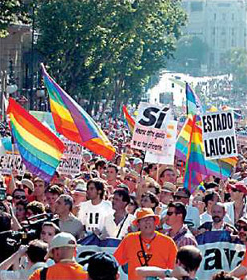
People in Spain celebrating their same-sex marriage victory in 2005; today, Massachusetts caught up.

The Massachusetts legislature knocked down the effort to try to advance a constitutional amendment to ban same sex marriage here. How did we win in Massachusetts? Well, many people made many different kinds of contributions.

From the New York Times today:
Senator Gale Candaras also voted against the amendment today, although she had supported it as a state representative in January. She said her vote reflected constituent views in her larger, more progressive state Senate district; her fear of a vicious referendum campaign; and the 6,800 anti-amendment e-mails, phone calls and faxes she received, one call every three minutes.

Most moving, she said, were older constituents who first supported the amendment, but changed after meeting with gay men and lesbians.

One woman had “asked me to put it on the ballot for a vote, but since then a lovely couple moved in,” Ms. Candaras said. “She said, ‘They help me with my lawn, and if there can’t be marriage in Massachusetts, they’ll leave and they can’t help me with my lawn.’ ”


More seriously, here's a lengthier statement from Senator Candaras on why she changed her vote.