Showing posts with label psychiatry. Show all posts

Monday, April 16, 2007

The doctors of The Sopranos

The Sopranos is a show about the frailty of mafiosi; because of this, it's a show about the power of medicine.

Tony Soprano's sessions with his psychiatrist frame the show by showing Tony's psychological frailty; in fact, the whole show started with Tony going to the psychiatrist because of panic attacks.

After a long struggle, Tony has basically given in to the psychotherapeutic approach to his own narrative. This week, Dr. Melfi asked, "Are you sure you aren't reading too much into this?" Tony replies, "I been comin' here for years. I know too much about the subconscious now."

Another running theme of the show has been the top bosses getting knocked down not by their enemies, but by their own physical frailty.

This week, New York boss Johnny Sack got bad news about his lung cancer, first from a specialist he flew to see, and then from a fellow inmate working as a hospital orderly. The orderly had been an oncologist, specializing in liver cancer, before shooting his wife and two others. "You saw Cohen?" the oncologist-orderly asks Sacks, flipping through Sack's chart when the prison doctor isn't looking. Sacks asks, you know him?

"I saw him talk once at an ASCO meeting." (That's American Society of Clinical Oncology to you, bub.)

The oncologist-turned-orderly is film director Sydney Pollack, who looks and acts exactly right for the role. I've seen a dozen internists who look and talk just like this guy. (Tony's psychiatrist's psychiatrist is played by film director Peter Bogdanovich, who does look like a psychiatrist.)

First Pollack's oncologist character tells Johnny Sack he should live longer than Dr Cohen has told him. Then, as the disease progresses, he says, "The aggressiveness. It surprises me. I've gotta concur with Cohen."

Johnny Sacks has brain metastases ("The headaches", he says, when Cohen tells him, recognizing the correlation of disease progression and symptoms); Phil Leotardo is still melancholy after his 5-vessel CABG; Tony had his long stay in the ICU.

And Paulie is super-proud of himself for "beating" prostate cancer. He thinks he's a badass for that; when Paulie proudly contrasts his survival to the death of Johnny Sacks, he thinks he's comparing like and like. Actually, comparing localized prostate cancer to metastatic lung cancer is like comparing Paulie Walnuts to Johnny Sack, seriousness-wise. (Though metastatic prostate cancer can be terribly painful and frighteningly lethal, localized prostate cancer is extremely common among older men, and more people die with it than of it.)

The feds make their mark from time to time, but they're mainly annoyances. On The Sopranos, the only people who are always more powerful than the mob–even in prison, there's an oncologist who tells Johnny Sack he's going to die–are doctors.

It makes sense. Doctors are probably the only people who can illuminate a mobster's deep psychological and physical frailty, and still have the mobster thank them for it. That's why a show that is about the frailty of mobsters needs doctors.

Postscript: I was struck by how Leroy Sievers, who's blogging about his cancer on NPR.org, saw this episode differently. He was struck by the episode (and a little bothered by it, despite his wishes not to be) because Johnny Sack's course was so realistic. I was impressed by that too, but I didn't think about it much. It just made sense. If they're going to show the underlings being shot to death, why not show the bosses die of cancer with the same realism? But the fact that the cancer part didn't bother me (while the gunshots still make me wince) probably just confirms that I've spent a lot of time in the hospital, and on oncology floors specifically. Johnny Sack's death seemed ordinary to me. I'm sure that's different from how I would have seen this three years ago.

Saturday, April 14, 2007

The "New York System", and health.


Providence, Rhode Island, is famous for many things. Paradoxically, one of its most important cultural contributions is called "The New York System". Present-day proponents of the New York System have been able to find no actual historical connection to New York.

One of the most well-known denominations of the New York System is the Olneyville New York System, a two-diner chain. As their website demonstrates, they make the New York System open-source in order to sell its proprietary New York System spicy sauce in their diners and at Shaw's supermarkets around Rhode Island. Their description of how to implement the New York System is detailed and informative. In brief, the New York System involves wieners cut from chains of links (hence they have their ends chopped off and do not look like ballpark franks); put in hot dog buns; and covered in spicy ground beef and onions and mustard. If you order enough at one time, the preparer lines the wieners in buns up his arm and plops the toppings quickly down the arm, hitting each wiener in succession.

(This maneuver is rumored to be the source of Rhode Island School of Design alum and former Original New York System employee David Byrne's mysterious chopping dance for the Talking Heads' song "Once in a Lifetime", seen in this video where he makes chopping motions up his arm at 3:56, and in many other performances of this song, as he shouts "Same as it ever was! Same as it ever was!" Please note that this original post mistakenly said that Mr. Byrne worked at Olneyville New York System. This is incorrect. He worked at the rival Original New York System. Hemodynamics apologizes for the error. Please see this Boston Globe article for a more complete account.)


The Olneyville New York System also offers coffee milk, which is milk with sweet coffee syrup, like chocolate milk, but it's not chocolate. It's coffee. Coffee milk.

Long-time residents of Providence no doubt take these wonders of American regional cuisine for granted, but Ms. Hemodynamics and I did not. ONYS is an old-style diner with a long counter and little waist-high booths throughout. An especially large and friendly man greeted us and took our orders, talked to us about Boston, and made us feel welcome. (Although after I admitted that I had not previously partaken of the New York System, he shouted, "We got virgins! Virgins here!" Olneyville New York System does not shy away from schtick.) We started in on our coffee milk and then soon were digging in to our ONYS wieners.

Here are some of the most important things to know about the Olneyville New York System wieners, from a health perspective.

First, we were pleased to see that no acute coronary syndromes were in progress among the patrons, most of whom were men on the older and larger side, who we guessed might be mostly descendants of people from the northern shores of the Mediterranean (let's say Greece, Italy, and add in Portugal even though it's on the other side of the peninsula), and who appeared to be ONYS veterans. This suggests that the ONYS may have mysterious healing powers that counteract the effects of its ingredients. (See below.) Admittedly, perhaps some other aspect of their diet cancels the ONYS out; but perhaps the ONYS sauce has some kind of anti-oxidant ingredient. Further research will be required.

The second lesson was learned by a black woman who came in with her daughter, and immediately looked worried. (If you looked at the clientele, and you were a black woman, you probably would have been at the very least uncertain, although while we were there no one gave any special cause for worry.) Sensing this, I think, the warm counter man took great pains to make the mom and daughter feel welcome. He described the ONYS wiener to them, with enthusiasm. She said, "It's a chili dog." (She was clearly torn: compelled enough by this strange place to see what it was, yet also not wanting to let anyone get one over on her.)

"No, no, it's not a chili dog," he said, with a small, confident smile. "You'll see." We didn't stick around long enough to see her reaction, but we hope she liked it as much as we did.

Later that day, I talked to my friend R. who had called me about planning a trip. I told him about the wieners.

"It's a chili dog," he said.

"No," I said, "It is not a chili dog."

It is not a chili dog.

It is very very tasty, however. It also contains what may have been 1.5 kg of fat, although it was hard to be sure; and this was our third health lesson.

The ONYS wiener is not a heart-healthy meal. Accompanying your ONYS wieners with coffee milk and a plate of fries, as we did, does not help matters.

Although the cardiac effects of ONYS are probably mostly long-term, the gastrointestinal effects are not. About fifteen minutes after completing my ONYS meal, I felt as if my stomach was squeezing down on a rock. I had some acid reflux. The rock stayed in my stomach for hours thereafter. My esophagus burned for hours.

And yet, I wouldn't have traded it.

We were not two bites into our ONYS wieners when Ms Hemodynamics said, "This was worth the trip right here." (She was referring not only to the wiener but the combination of wiener and ambience.)

There was nothing healthy about the ONYS wiener, from a physical standpoint. But the psychological effects were overwhelmingly positive. Sure, there was the fat-triggered dopamine surge. But we also felt happy and cared-for at Olneyville New York System. And we felt proud: after a confusing drive past iron-barred corner stores and many Guatemalan and Salvadoran restaurants ("Have you ever had pupusas?" I asked Ms Hemodynamics, as we looked for ONYS and I started thinking about back-up plans) finding the ONYS suddenly in front of us felt like a victory in itself.

So although the ONYS wiener had immediate and obvious effects on our physical health, it was our mental state that took priority. The ONYS was definitely bad for my heart and my GI tract. But it was good for my soul.

A last note: the host pointed to a gentleman who looked to be in his 70s, and said, "My uncle. 101 years old. My late mother, his sister, said, God forbid if I should go before him, take care of him. And she didn't mean like a nursing home. She meant, TAKE CARE of him, like with a gun. But I didn't do it. So here he is. My uncle. A hundred and one." (He was not 101 years old.)

"What's the secret?" I asked the uncle, who had clearly heard this schtick before, and was digging into his wiener without comment. "Is it the wieners?"

"Absolutely," he said.

Tuesday, April 10, 2007

What's a doctor? (When in doubt, return to Oliver Sacks.)


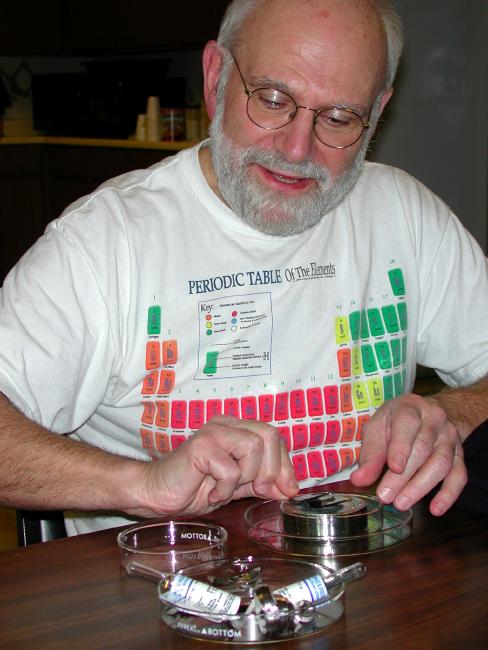
[Picture from the website of Theodore Gray, who had what looks like a great day with Oliver Sacks.]

Is a doctor a consultant, giving her patients advice about how to select medical interventions (or avoid them) based on her understanding of her patient's values? Or is she something else--something more complicated, and emotional?

I was thinking about this after part of a small discussion/debate with one of my favorite teachers, someone who makes it a big part of her job to be extremely thoughtful about the doctor-patient relationship. In my thesis (which I defended yesterday), I cited Robert Rimer, a person with AIDS who wrote a book called "HIV+: Working The System" in 1993, who describes a doctor as being a consultant to the patient; she was responding to this theme with both agreement and skepticism.

But I was thinking about the conversation later in part because I misunderstood part of one of the questions my teacher was asking in our conversation. In retrospect, I think she was arguing that part of what a doctor is supposed to do is care, not just in the sense of providing medical care, but also building an emotional connection and a sense of emotional investment that both the doctor and the patient feel. I agree that this is an important–and extremely rewarding–part of the doctor's job. But when she said, "You describe this as a very intellectual kind of relationship" I agreed with that too.

I'd like to think that part of how I care for people is to be their expert, to be the dork that works for them, their personal geek. And I'm skeptical about the people who dwell too much on the theme of "humanism in medicine", which I think more often than not is just the latest medical buzz phrase for common decency–and yet another chance to pat ourselves on the back. I think doctors are supposed to be decent human beings who treat their patients with respect and concern, but I don't think that's any special calling or anything unique to medicine. I think it's a basic rule of human interaction in an egalitarian society.

Of course, when we are talking with our doctors about really serious parts of our lives, we need to believe that they care about the content of our conversation. And I admit that there is a unique kind of vulnerability that we have with our doctors. Often we are talking with doctors about our own physical frailty, our mortality, and the private intimacies of bodily sensations, bad smells, and objectionable substances. These are things we go to great lengths to hide under all other circumstances.

And so there is also a special emotional obligation on doctors to honor and attend to that vulnerability. And it's true that this is where the "consultant" metaphor begins to break down a little. This vulnerability, not to mention social class, social convention, and even the architecture of the exam room, all conspire to create a real power difference between patient and doctor that is not quite like a classic consulting relationship.

This is not some corporate CEO calling in some Harvard kid who works for McKinsey, to ask how to improve web site traffic.

The emotional currents that run between doctor and patient make a kind of live wire. Those currents can be exploited on both ends. Doctors get a lot of training (especially informal training, which often reinforces some bad values) on how to prevent getting used and manipulated by people who are walking into the clinic or the hospital with a set of agendas that doctors don't want to serve. Psychiatrists spend a lot of time talking to each other about monitoring their own emotions during sessions as a way of using their own emotional state as a kind of sensor to help them understand what the patient is going through. For instance, if psychiatrists start to feel agitated and confused during a visit, if they can stand back from that sensation for a moment they can recognize what it is about the patient (usually agitation and confusion) that is triggering this feeling.

But most patients walk in without that kind of tool. When the electricity of powerful emotions begins in the exam room, they're caught without gloves on. This sometimes clouds people's thinking and makes it difficult to contrast their own agendas with the doctor's agenda. When this happens, it's not until later, when they've left the exam room and gone home, and the electrical current fades and then shuts off, that they realize that they wanted something different from this visit than the doctor did. In other words, I think sometimes people can sink into the emotional connection they get from the clinic–which can be powerful–and lose the ability to clearly and precisely advocate for themselves.

So when I talk about being a consultant, it is not with the aim of eliminating emotion from the exam room, nor with the aim of failing to care for the patient. But that care has to give some breathing room; it can't be enveloping, or it will suffocate the patient's own power and initiative, or constrain its birth and growth.

Anatole Broyard wrote:
"My ideal doctor would be my Virgil, leading me through my purgatory or inferno, pointing out the sights as we go. He would resemble Oliver Sacks, the neurologist who wrote Awakenings and The Man Who Mistook His Wife for a Hat. I can imagine Dr. Sacks entering my condition, looking around at it from the inside like a benevolent landlord with a tenant, trying to see how he could make the premises more livable for me. He would see the genius of my illness. He would mingle his daemon with mine: we would wrestle with my fate together."

This is a complicated, even jumbled, set of metaphors. But the ideas are useful, and not just because they're about Oliver Sacks. Broyard describes the doctor first as a guide; and then, as a kind of owner of one's own condition, a guide who can not only show you around but help improve the premises.

In this way of describing the doctor, the doctor is important because of his expertise; but also because he employs that expertise with kindness. It's important here to note that Oliver Sacks as a man is actually frankly odd, or so it seems from his lovely book Oaxaca Journal. In the book he takes a tour of Oaxaca with a group of fern aficionados; he is also a quite dedicated fern aficionado. He often sets himself apart from the group, most of whom are paired off in couples. He is clearly the nerd, and the striking thing about this, of course, is that he is the nerd among a group of people who have devoted a considerable amount of their free time to thinking about ferns.

Nonetheless, after a while, he begins to become engaged in some mild running jokes with a couple of his fellow travelers, and to build relationships in a way that seems totally ordinary to me as a reader. (He seems to be thrilled by one of his dorky running jokes, even perhaps by the very idea of a running joke. I have this kind of running joke with various people in my world all the time, as do most of you, dear readers.) And yet by the end of his trip he feels completely happy in a way that he rarely has before.

He writes:

"I myself may be the only single person here, but I have been single, a singleton, all my life. Yet here this does not matter in the least, either. I have a strong feeling of being one of the group, of belonging, of communal affection–a feeling that is extremely rare in my life, and may be in part a cause of a strange "symptom" that I have had, an odd feeling in the last day or so, which I was hard put to diagnose, and first ascribed to the altitude. It was, I suddenly realized, a feeling of joy, a feeling so unusual I was slow to recognize it. There are many causes for this joyousness, I suspect–the plants, the ruins, the people of Oaxaca–but the sense of this sweet community, belonging, is surely a part of it."


I believe, reading Oliver Sacks, that he must be a good doctor. Clearly Anatole Broyard believed the same thing. And yet if we are to believe his journal it seems to take him completely by surprise to feel a sense of belonging among other human beings, and that only transiently. How can this be if the essence of being a good doctor is human connection?

There are a couple of possible answers. One is that Oliver Sacks is a wonderful writer but a lousy doctor. It's hard to know if this is true, but even harder to believe. Another is that Oliver Sacks feels as if he is not making human connections even when he is. This seems more likely.

Most of all, Oaxaca Journal made me think that Oliver Sacks has a sense of solidarity with his patients in the neurology clinic, in the sense that he is acutely and intuitively aware of the idea of neurodiversity. However it is that his brain works, he is quite aware that it is not like other peoples' brains. And when Temple Grandin described herself as "an anthropologist on Mars", and he titled his book of essays with this phrase, it's hard not to wonder whether Sacks himself does not feel sometimes like an anthropologist on Mars, albeit a very kind and enthusiastic anthropologist.

But we know for sure that Oliver Sacks is driven by fascination, by intellectual interest in people and how they think and how they perceive the world. He is able to be fascinated in a kind way, and his fascination is infused by solidarity. And this is what is moving and wonderful about his writing. I think this is also what probably makes him a good doctor, and a good consultant.

He is not taking you out of hell, though if he can walk you towards the door out, he will. He is showing you around, and explaining what is going on there, and working with you to see if things can be better if this turns out to be where you are going to have to live. Anatole Broyard and I read Oliver Sacks and see this in him, and we think that this seems like what a doctor is supposed to be.

I hope to do the same for my patients: to be kindly fascinated, to feel a sense of solidarity with them, and help show them around. Is this caring? Sort of; in fact, it can even feel like a kind of love. But not exactly. It is not a parental or even a fraternal kind of love; it is not even friendship, really.

When we are ill, and live in fogs of pain or nausea or fear of death, it is the people who love us who should love us, and hold us, and remind us of what is good about the fact that we lived on this world and breathed its air. Doctors can do this in a pinch; but so too can many other people. Most people think their nurses are actually better at it.

So what's the point of a doctor? What's the doctor supposed to be? The answer is somewhere in this area of metaphors, of consultants and guides. The point of the doctor is to illuminate the inner landscape and history of our own bodies, to show us around when it becomes confusing, to suggest a way out when we get lost, or a way to get comfortable if we are trapped.

If I did not believe deeply in the value of that expertise, and if I only wanted to be kind and concretely useful to people who were suffering, I would have been a nurse, or perhaps a hospice volunteer. I actually spent a lot of time thinking about this choice, and it was not an easy one for me. But to become a doctor, I needed to accept the idea that I am not first a carer. I am a guide, who cares.

Thursday, March 29, 2007

Reason for consult: "This patient is driving me crazy"

I've just finished my last rotation of medical school. Half of it involved working on a psychiatry consult team, which was a new experience for me.

Consult teams are a big part of how big academic hospitals work; when your primary team calls in an expert to consult, your team is "calling a consult." And I found last month that a common reason to call a psychiatry consult can be summed up as "This patient is driving me crazy!"– expressed in more technical terms, of course. Some of the consult team wryly referred to these as "staff distress consults."

One version of the "this patient is driving me crazy" consult is often the question of capacity. Capacity is determined by doctors – mainly, psychiatrists. They decide whether you have the ability (and therefore the right) to make decisions about your own health care. This is one place where your right to autonomy can be taken from you: the law assumes that to be autonomous you need to have the cognitive capacity to make autonomous decisions. Reasonable enough, but obviously there's a lot of wiggle room in how you define that capacity, and who decides whether you have it.

Competence is the legal term; if you do not have capacity, a court can declare you to be not competent. If you're not competent, the court will require you to have a guardian to represent your interests – and if no one is immediately available or your family is arguing about who should do it, the court can appoint a guardian. If you google "capacity" and "competence" together, you'll get a set of instructions for residents from one institution about how to approach this issue. It rightly instructs doctors to evaluate capacity even when the patient agrees with their recommendations.

But I can't remember ever seeing a consult like that. In my limited experience, capacity most often gets evaluated when a patient disagrees with the doctor for what the doctor thinks are wacky reasons, and can't be budged: thus, the "this patient is driving me crazy!" undertone. A common variant: "The patient doesn't want surgery which I have told her she needs, and the fact that I can't just tell her what to do is driving me crazy."

When the patient agrees, even if they have completely cuckoo-for-cocoa-puffs reasons for agreeing, the doctor is more likely to feel that the patient has the capacity to make medical decisions, because the patient is making a good decision; that is, the patient is making the decision that the doctor has already decided.

Hospitals concerned about quality and patient dignity should evaluate the purpose of capacity consults, to establish the ratio of calls for a capacity evaluation of patients who disagree with their doctor, versus patients who agree. If capacity evaluations were being conducted appropriately, the ratio should be around 1:1. It doesn't take long working on a psychiatric consult service to think that a 1:1 ratio seems impossibly utopian. But it would be good to try.