Thursday, October 23, 2008

Fish-for-Sex


This journal abstract caught my eye while searching for something else having to do with economics and HIV risk:


Women and Fish-for-Sex: Transactional Sex, HIV/AIDS and Gender in African Fisheries

Christophe Bénéa and Sonja Mertenb

WorldFish Center, Africa Regional Office, Cairo, Egypt; University of Basel, Switzerland
Accepted 22 May 2007. Available online 10 March 2008.

Summary

This paper analyzes the phenomenon of fish-for-sex in small-scale fisheries and discusses its apparent links to HIV/AIDS and transactional sex practices. The research reveals that fish-for-sex is not an anecdotal phenomenon but a practice increasingly reported in many different developing countries, with the largest number of cases observed in Sub-Saharan African inland fisheries. An overview of the main narratives that attempt to explain the occurrence of FFS practices is presented, along with other discourses and preconceptions, and their limits discussed. The analysis outlines the many different and complex dimensions of fish-for-sex transactions. The paper concludes with a set of recommendations.

Key words: artisanal fisheries; vulnerability; poverty; public health; Africa


It's actually a pretty thoughtful article and among other things makes sure we don't oversimplify the fish-for-sex phenomenon which I have to say I was immediately tempted to do. For instance, one thing that I didn't think about right off the bat was that "[W]omen fish traders—whatever way they ‘purchase’ the fish, i.e., with cash or through sexual arrangement—are economically productive agents within the fisheries sector... [and are] fully integrated in the fish value-chain" which despite the absurdity of that last phrase, appears to actually be a fair point (see below).


"Women engaging in FFS transactions are often depicted as sex-workers by their own community/society, conveying more or less explicitly a link between FFS and prostitution. While prostitution undeniably exists in the sector and fishers are certainly one of the socio-professional groups which have the most frequent contacts with sex-workers, assimilating FFS to sex-workers is socially and economically questionable. In particular, it does not acknowledge the fact that women fish traders—whatever way they ‘purchase’ the fish, i.e., with cash or through sexual arrangement—are economically productive agents within the fisheries sector: like any other fish traders, they process, transport, and retail fish. They are thus fully integrated in the fish value-chain, in contrast to sex-workers who do not create direct value-added in the sector.

"The association FFS-prostitution is also recurrently brought forward as part of the narrative of the poor, destitute woman who is forced to prostitute herself to buy fish—cf. Table 4. Although it can hardly be denied that female fish traders can be remarkably vulnerable to poverty—in particular the widows, single mothers, or divorced women—assuming a systematic link between extreme poverty and transactional sex may be too simplistic to capture the complexity of the factors leading women to engage in FFS. In particular it does not reflect the fact that women are socially active agents who may rationally choose their behaviors and negotiate the nature and continuance of their relationships with their partners. What, instead, the quotations listed in Table 4 may illustrate is that a large part of the literature essentially from NGOs and advocacy groups that focus on addressing extreme destitution and poverty among vulnerable groups (and in particular women) tend to use extensively or to instrumentalize the narrative of 'the poor woman who is forced to prostitute herself to survive' in order to draw public attention to their own cause."

And:
"The existing documents reporting FFS indicate that a large proportion of the women who engage in FFS are widows, divorced or single women, re-emphasizing the relatively high vulnerability of this group to poverty and thereby reflecting the safety-net role that fish trading activities traditionally play for a large number of poor women, especially in Africa. This link between FFS and female fish traders’ vulnerability has been captured and reflected in a certain number of narratives and discourses which attempt to explain the occurrence of these practices. The most frequent one is probably the miserabilism narrative where FFS is viewed as a 'strategy for survival' and women engaging in FFS as victims. Linked to this perception and reinforcing it is the very frequent confusion made between FFS and prostitution. While this article demonstrates why this confusion is disputable, it also recognizes that the increasing vulnerability of female traders is a reality which certainly reduces the negotiation/transaction power of these women, and also encourages fishers to impose these FFS transactions through 'no-deal no-fish' coercive arrangements. At the same time, the new institutional economic approach proposes an alternative to the miserabilism narrative and highlights the transactional dimension of FFS practices, suggesting that the lack of cash may not systematically be the only determinant that leads women to engage in FFS. Surely, there is no contradiction between these two interpretations. Social structures or institutions, class, gender inequality, kinship, and marriage do have a bearing on women’s decisions, but those must still be seen as social actors with some power to negotiate."

Follow-up to McCain and melanoma

Kyle makes a couple of arguments below in the comments of my last post, and my reply is long enough and separate enough from my original post that I'm posting it separately:

Kyle,
I don't disagree with your political conclusion of what to do at the end of the day. The point is that any president might die. The fallacies of the Altman argument are that:

1) the medical chart does not contain information on what is most likely to kill a president; and
2) John McCain has some unknown risk of recurrent melanoma, which further information might allow us to calculate slightly differently than what we know to be his generic risk without further information. But John McCain either will or will not die in office if elected. And, with or without melanoma, he has a reasonable probability of dying in office because US presidents generically do have a much higher probability of dying in a given four year span than many other people, entirely because of the risks associated with the office rather than the officeholder.

So whether the possibility is x% chance of melanoma combined with y% chance of cardiac disease combined with z% chance of lung cancer, the generic risk to the officeholder already meets a test of likelihood. That is, statistically, taking any president at any age, a generic voter should assume--regardless of what is in the medical chart--that the president is at least as likely to die before the end of the term as the voter herself, or at least, the voter's children.

So, the reason this is relevant to a medical blog and a medical argument is that melanoma in particular should not change the intervention--i.e., your vote. Whether or not he has a given chance of recurrent melanoma, Sarah Palin is not a qualified vice president, and she has a high generic chance of becoming president if elected as vice president.

Incidentally, though the two candidates' generic risks of mortality can be influenced by their age, this is an easily discernible and intuitively obvious risk which does not require Lawrence Altman digging through colonoscopy reports.

Because the baseline presidential risk of death is high, the issue of Sarah Palin's competence is more or less exactly the same as the issue of Joe Biden's competence. If Obama had picked Palin, it would be just as bad a pick, for the exact same reason.

Now, take the low-probability but possible chance of Lawrence Altman finding something in the chart that a group of Mayo Clinic doctors deliberately concealed or misrepresented when they vouched for McCain's health. When going through McCain's chart, the greatest likelihood is that whatever Altman would find would be a "false-positive"--that is, it would raise concerns for voters but would not actually change the outcome of the next four years.

That would be unfair to McCain, and more importantly to democracy in general. It would represent a medicalization of democracy--a completely out-of-proportion ability of a few doctors and medical screening tests to influence democratic elections.

Also, at least as importantly, it would be unfair to anyone with "concerning" things in their medical charts who wanted to be in a powerful position. There is no magic about a president; to the workers of a company, the CEO and CFO might well have greater power to determine their quality of life in the next four years. So, should boards of directors have the right to examine every bit of the medical record of any executive? And how far down the management trail are you willing to go with that logic? And what does that mean for people with family history of genetic diseases, for people with past medical issues, for people with high epidemiological risk?

Aside from this, I want to make sure I am clear about the statistical and medical argument I'm making, so let me take a less-loaded and very common medical parallel. Let's say someone comes into the emergency department with shortness of breath and a fast heart rate. There are various possibilities. One is a blood clot in the lung, known as a pulmonary embolism (PE).

To diagnose PE, I can get a CT scan with contrast, which can damage the kidneys. I can also do a blood test, the result of which will increase or decrease my estimate of the chance that the person has a PE. If the blood test increases my estimate, I'll get a CT scan. If it decreases my estimate, I won't get a CT scan.

So, if I think there is a clear alternative explanation and no reason to suspect PE, should I get the blood test? No, because it will not change my decisionmaking. I am more likely to get a false positive than a true positive, and therefore, the CT scan is more likely to be dangerous than helpful.

What if it's someone has a very high risk of pulmonary embolism--a known clot in the veins of the leg, and cancer which predisposes to PE? Will I do the blood test? No, because I don't care if the test is negative. I will still not be satisfied until I do the CT scan.

So it turns out that the only time to do the blood test is if you're not sure whether or not a PE is likely--the risk is indeterminate, or "medium-risk." The argument Altman is making relies on the idea that a medical chart is the equivalent of this blood test. That is, you will cast your vote--the potentially wise or unwise and highly consequential decision, the equivalent of CT scan with contrast--based on the information in the medical chart. This is a common issue in medicine: will a given test change your medical choices? If not, why are you doing the test?

Given that the Altman chart review is the equivalent of the "medium-risk" blood test, where we are trying to convince ourselves that a candidate will very likely die in office or will very likely not die in office. But this is not the right choice from the point of view of the "change your choice" test. That's because a president is not medium risk for death in the next four years. At least historically, a president is high risk. So, I certainly will not fail to care about the qualifications of a vice president. But I will not use the medical chart to decide how much I care. I already care a lot, because I know no matter what the chart says, I care. Any reasonable person should vote with the assumption that a president has a high chance of dying in office.

If examining the chart had no impact, then it wouldn't matter. And I'm the last person to defend McCain.

But I'm not defending McCain or a decision to vote for him. I'm defending people with a history of melanoma, and a lot of other people too. For anyone with higher probabilities of disease (whether through genetics, behavior, or past medical history), the risk of making the argument Altman is making is actually quite high. So, thinking through the issue of whether you do a test, and whether the Altman chart review is a test we should be doing:

the test does not change my ultimate decision
the test has a high chance of falsely influencing my thinking
the test has a high chance of other bad effects.

And therefore, the test should not be conducted. And Lawrence Altman doesn't need to look through every page of John McCain's medical chart.

[edited for clarity later in the day]

I vote against John McCain because he is a risk to people with melanoma, not because of his risk of melanoma.

Before I go any farther, let me just say that this post is the one time I'll say anything sympathetic about John McCain who I desperately hope loses this election and loses big. But this isn't about him, really.

It seems like during most election seasons, the New York Times' Lawrence Altman MD seems to get worked up about whether he has had enough access to political candidates' health records. Altman was a medical resident about 40 years ago and has never been much of a clinician as far as I can tell besides that--he did preventive health, public health work, and journalism. But, he seems to feel that reporters--and especially, he, being a doctor/reporter--have a right to go over presidential candidates' health records.

This is an appalling idea if we take away John McCain and our hope to see him lose, and think about this in the abstract. And I'm frustrated that a bunch of doctors who support Obama have apparently signed some kind of letter asking that McCain release all his medical records, and that some of them are saying a bunch of stuff in public about his melanoma risk. First of all, I don't know anything more about John McCain's melanoma risk than Bill Frist knew about Terri Schiavo's neurological function, which is to say, I know better than to pronounce my opinion about it.

Second of all, if I was able to look at all of John McCain's medical records, do a physical exam and history, and then quickly become a melanoma expert, does risk for a serious health condition mean that you're supposed to bow out of public life? If you think so, how far down does this argument apply? Governor? Mayor? City Council? Why would it stop at any particular level of office? If the argument is reasonable at the top, why shouldn't the voters of any given town know whether their mayor had guaiac-positive stool? Is it relevant to know whether your congressional candidate might have a brain aneurysm? Is it your right--no, your duty as a citizen--to demand full body CT scans and head MRIs for every person entering any political race at all? As a doctor, shouldn't I reserve my vote only for the candidate who puts his colonoscopy report up on the web so I can look inside his ass and judge for myself whether his polyps are sufficiently presidential?

John McCain's health plans mean his risk to people with melanoma is much more significant than his own risk of melanoma.

Finally, epidemiologically, the melanoma argument opens the door to a truly terrible line of logic, because underneath the medical argument must always be an epidemiological argument. By far the most common cause of death among US presidents in office is assassination. And deaths from cholera or bacterial pneumonia are unlikely for current US presidents. For all of Lawrence Altman's piety about presidents concealing their medical conditions, JFK hiding his Addison's disease was obviously irrelevant in the larger scheme of things. If we're so concerned about a president's chances of death, should we ask Lawrence Altman to be joined by security experts who can analyze the candidates' risk for being assassinated before we vote, which in presidential epidemiology is more likely than death from cancer? Does the public have a right to read all the death threats sent to presidential candidates so we can judge for ourselves whether they are serious? Shouldn't the Secret Service be granting the public complete access to suspected or potential assassins-in-the-making to assess whether they are serious threats or just rifle-toting equivalents of negative lymph nodes? In this election, I don't even want to think about such a thing.

So presidential epidemiology be damned; I am casting my vote for a black man with a significant smoking history and a bunch of racists who want him dead. I'm voting for him because of who he is while he is alive, not because of my morbid guesses about when he might die.

(If you want to be a doctor for Obama, here's a more reasonable way to do it.)

Monday, October 20, 2008

Rachel Getting Married

This weekend, we saw a great movie.

It's been a while since Ms Dr Hemodynamics and I have had an actual date, what with lots of night float shifts, lots of moving and fire logistics, and lots of just plain being overwhelmed by events. But Friday night we had a great date. When we met in medical school one of the first conversations we had was after I said I'd just seen The Station Agent and how I thought it felt--in its smallness, its authenticity, and most of all its particularness, the way it was a story just about these people and no one else--like You Can Count On Me. She said, "I loved that movie!" and that started one of those early conversations where we realized we had some tastes and ways of looking at the world that might match up. Another one of those conversations took place at the B-Side Lounge, a restaurant not far from a movie theater we like, where we went for our first date.

So last night, as if to restart our dating life after all the chaos in our lives, we went to the movies and then the B-Side. The movie was Rachel Getting Married, written by Jenny Lumet (Sidney Lumet's daughter) and directed by Jonathan Demme. The writing is smart, with natural-sounding dialogue supporting a tightly-structured story. The casting is so rich and the acting so good that even minor characters seem like interesting people, believable people. And like The Station Agent and You Can Count On Me, these characters don't belong anywhere else except in this story, this movie, and for that reason, they fill the movie and seem to live beyond it. Demme keeps the hand-held cameras moving, but close-in; we are guests at this wedding, not omniscient viewers.

Anne Hathaway is the center of the movie as Kym, Rachel's addict sister, back from rehab on furlough to see her sister get married. She starts the movie as a completely irritating and totally self-centered person who seems mostly frustrated that her sister's wedding is not really about her. Kym never turns into an angel, but the depth of her character and the complexity of her relationship to her family slowly evolves beyond addiction's irritating interpersonal effects and into its more profound pain and tragedies. I ended up feeling strongly connected to her even as her tally of bad deeds and pain caused becomes larger and more awful as the movie goes on. The movie seems as if it is about her, and thus about a family's relationship to an addict--and it is. But we come to realize the movie is also about something and someone else: a family's relationship to a person who isn't present at all, except in all the main characters' thoughts.

The movie revolves around Kym, and that means it's not a big sprawling multi-character document of a family; it's a much smaller movie than that. Nonetheless, it becomes an ensemble movie because the actors playing the other characters are compelling and interesting enough that you begin to get a sense of them as people just by watching them watch Kym. Bill Irwin, Anna Deavere Smith, and Tunde Adebimpe are all people with their own creative agendas, and their intelligence and watchfulness is part of what makes each of them so compelling as actors.

I'd love to know Kym and Rachel's dad, played by Irwin--he's a sweet, generous-spirited guy--but he'd clearly do well to get himself to a Nar-Anon meeting before he offers someone another sandwich. Irwin, a guy who has taken clowning to a new level of art, and plays Elmo's friend Mr. Noodle on Sesame Street, uses his big mobile face to underline the desperation of his hope that happiness can reign. His expressiveness and hope is contrasted with the cool distance of Debra Winger as Kym and Rachel's mother, who makes a late appearance in the wedding proceedings and in the movie, but makes every second count.

Tunde Adebimpe, of the band TV On The Radio, plays the groom, Sidney. He is a large almost awkward-seeming man, but his gentle kindness amidst the emotional chaos make it clear why Rachel needs him, and why she is so delighted to be marrying him. Sidney and his friends and family stand in contrast to Rachel and Kym's tense prickly family web. They are constantly in the background of the movie as a vision of ease and happiness that Rachel is trying to grab for, and Kym thinks she'll never have.

Go see it.

Saturday, October 18, 2008

No on 8--and yes for marriage equality


Gay marriage: it's not just for anonymous trailblazing ordinary people anymore--but even celebrities can get their rights taken away in November

If you make one political donation this season, the way to have the biggest long-term impact for your dollar is right here:

No On 8 Website

Yes, you should pony up for Obama--but lots of people are already doing that. Fewer people are donating to another important campaign, which means your donation can make an even bigger difference for the dollar. The campaign to save same sex marriage in California is an urgent moment for equality in the United States, and it will be a turning point for the struggle for equal rights for gays and lesbians. Recent polls show that the latest misleading ads for the proposition are working, and many Californians are prepared to vote for Proposition 8. If the election was held today, Prop 8 would win. That would be terrible news for my friends and family in California who need same-sex marriage for all kinds of practical reasons, and also some basic reasons of justice and equality.

I hope you'll join me in opposing Proposition 8. We in Massachusetts can breathe easy knowing that same sex marriage is safe here for now--but if it's defeated in California, the forces of intolerance will be coming back here to try to roll back the clock. I don't make a lot of money as a medical resident, but I just gave $200.00 to this campaign. I hope Hemodynamics readers will consider joining me--and if you do, let me know in the comments section of this post.

(PS: A challenge grant means that if you donate before Sunday October 19, your donation will be matched dollar for dollar--so you can double your already significant impact.)

Saturday, October 11, 2008

where there was smoke, there was fire


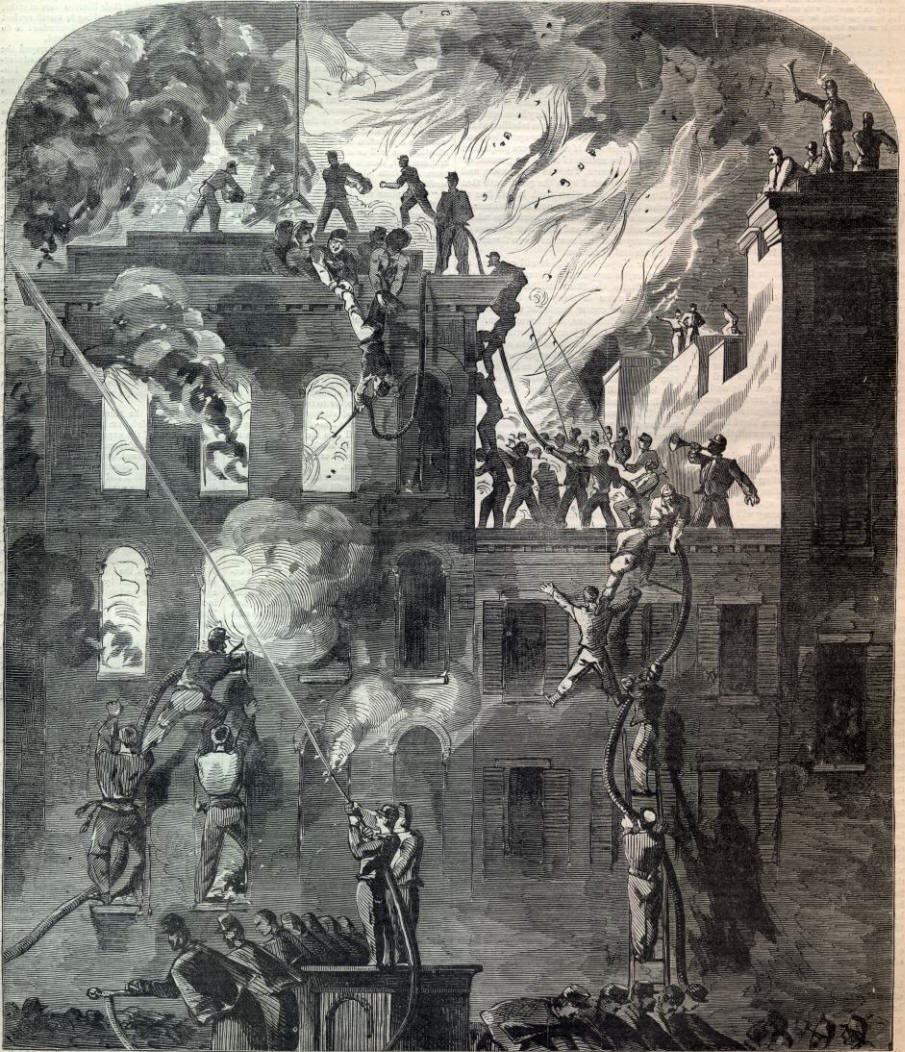
It's too long a story to tell here for now, and with too many complicated feelings to tell easily. But, we had a fire in our apartment building, and we were temporarily homeless (though in an upper-middle-class stay-at-your-friends' houses kind of way), and now temporarily housed. I feared for my life only in retrospect, and all of the Hemodynamics family got out safely.

We're actually back in our old building but in another part of it, subletting the apartment of someone who didn't want to come back while the building was being rebuilt. In our old apartment most of the walls and ceilings are now demolished: our apartment itself didn't burn, but the water of the hoses came down through the walls to our apartment from where the fire was being fought above.

The halls are full of the white plaster dust, and the floors in the halls are stripped down to the wood underneath them. Everything is dusty and each time I turn the corner I smell the smell of smoke, which just reminds me of that night. Coming back to our building means smelling smoke, both literally and figuratively. It means being reminded of a traumatic event. But it also means reclaiming that event not simply as a disruptive moment, but as something that is part of our history, and shapes our future. It smooths out the trauma, into the clay of the larger lives we build. I think it's a good thing.

In the hospital, I realized recently that I was in a "don't f- with me" mood. Without my clippers and feeling grumpy about buying new razors and other such things that the movers were supposed to return to us, but didn't, I let my beard grow into a unruly patchy mess. Facial-hair-wise it was if I was some kind of Che Guevara wannabe slouching through a Harvard hospital, just biding my time until I could really make some trouble. I was using swear words more than usual. I was making dark jokes more than usual.

Today, maybe it's a sign of starting to recover that I went to the barbershop, and got my beard trimmed, and my hair cut, and even got shaved above and below my beard line with a straight razor, an unprecedented event. Slowly, I think my unconscious mind is joining my conscious mind in rejoining the normal world.

Still, out in the hallway it smells like smoke. It's going to take a long time for that smell to go away.

Saturday, August 30, 2008

Manhunt, McCain, and the Boyfriend Problem

photo from gayparentingpage.com


I've been thinking a lot about gay male culture while I've been out in Provincetown. Gay male culture here is concentrated, combined, and distilled: here are the Bears, the dads with a kid and a Labrador, the club boys, and the drag queens. In the clinic, gay life becomes both more ordinary and more quietly charming when an old drag queen, i.e., an old queen who is actually old, comes in wearing flip flops and an old t-shirt to discuss diabetes management.

It's been bringing back some memories, but also some new ways of looking. Back in Boston, my life outside of work revolves around Ms. Dr. Hemodynamics and the Hemodynamic Cat. But when I was younger, my personal life and affections were more complicated. And I was doing HIV prevention work in San Francisco. In that time, I was a much closer observer of gay life, and sometimes an observer with more personal stakes in the questions of the day.

Back then, I was also living with a woman for much of the time I was doing that work; I've long been the male equivalent of that time-honored tradition among women's college alumni, the has-bians. But finding love with women has always caused me to reflect on the obstacles my gay male friends have in finding love with men, and to think about how they might solve the perennial Boyfriend Problem which seems to afflict so many. That road not taken looks pretty bumpy from over here on the paved expressway.

<<>>

I used to see gay life through some notion of gay culture, the community, something greater than the sum of the parts: that was how I saw gay life when I was an idealistic young person, and when I worked as a community organizer and public health worker. That makes sense. That's how idealists and public health workers (and especially, idealistic public health workers) are supposed to think.

Now I see gay culture one gay man by one gay man, each individual coming into my social circles or my clinic in the midst of all of the other people I encounter. I don't see a united culture or community in the way that I used to. Part of that is the product of seeing people through the lens of medicine instead of community organizing; medicine is individualizing.

At this remove, I now think that a lot of what I used to think of as "gay culture" is really mainly about of the lives of single gay men. Once gay men couple up, they remain part of the community, but they are often less visible, live elsewhere, and almost by definition spend more time with each other than they do with other men. They still come to the doctor's office, though, and so I'm reminded of them more than I used to be when I was a community organizer.

It's also true that Boston is different than San Francisco. Gay life is both less visible and less separate from the rest of the city. That doesn't mean that all of Boston's gay men are living in a closet, it just means that they don't all live in the South End, or any other neighborhood. And there is no designated space of outrageousness in the city itself, like San Francisco's Castro District, where any given night might mean an encounter with some crazy drag queen doing some nutty schtick. That space exists for Boston men, but it is 90 minutes away by fast ferry. It is tucked away down here in Provincetown, isolated from everything else, and seasonal. Its location is based, no doubt, on those two cherished New England values: freedom and discretion.

So I've changed my relationship to the gay world, my role in it, and my geographic position. And each of those changes means that I've personally moved much of my day-to-day view of gay life from neighborhood to individuals, from community problems to individual needs.

<<>>

But the change from community to individual seems to be happening in some other ways, too, which have nothing to do with my shifts in jobs or geography. Around the country, whether your local gay mecca is a distant refuge, or a right-in-the-middle-of-town liberated zone, geography has become less important to gay men. In part this is because the geography of cruising and hooking up with other men has become decentered and electronic, conducted through Internet hook-up sites like Manhunt.

And the rest of the geography of gay life may also be dispersing and diffusing, as younger men stop having to leave behind their straight friends from high school, college, or work behind when they come out. Straight culture's transformation towards increasing acceptance of gay lives in the last thirty years has meant that more and more queer people can lead social lives that have continuity with childhood and young adulthood, instead of requiring either a closet (as in the older days), or a complete break and reinvention (as in the slightly more recent days).

This all may mean that, as a Boston Globe think piece argued, gay bars will go the way of Jewish delis. Only a few iconic delis now survive as "Jewish Delis", living on as places of history built for occasional pilgrimages in from other neighborhoods or suburbs, rather than existing as true centers of community life. I think there could be worse fates for gay bars than for most to close and a few to become "Gay Bars" where men go on third dates for a fun experience of gay culture nostalgia, but not to meet their first date. Of course, the "Gay Bar" will be something less than the original, likely full of straight tourists buying kitschy "Gay Bar" t-shirts and getting their pictures taken with the drag queen at the door. But if you had to choose whether gay bars should be more or less prominent features of our cities and of gay men's lives, I think it's not unreasonable to choose "less." There are others who can sponsor gay softball teams.

<<>>

But the internet's role is potentially more troubling than whether it may be biting into gay bar profit margins. A recent essay in Out.com, entitled "Has Manhunt Destroyed Gay Culture?" by Michael Joseph Gross, is partly an essay that could have been (and has been) written any time in the last thirty years of gay culture. It laments gay men's focus on sex which it argues precludes a focus on longer and more meaningful relationships. I found this article because of my political junkie Internet addiction which led me to the controversy about one of Manhunt's founders donating as much money as the law allowed to John McCain.

The part that could have been written any time since the 1970s and perhaps earlier is as follows:

But the most powerful secrets that live on Manhunt aren’t the ones we keep from the outside world. The most powerful secrets on Manhunt are the ones we keep from ourselves. Practically every gay man has his own version of this secret, which we learned to keep while growing up in the closet: the secret fear that, if we were truly known, we would never be loved.

This is probably as true (but over-simplified) today as it was in 1978 when Larry Kramer was working this angle, though probably not more true. However, because there is so much more capacity to create visual images quickly, including movies and digital self-portraits that require no photo lab technician to see the photo, people are becoming pornified, and pornifying themselves, in a way that they weren't before. The fact that more of the sex is virtual is only good from a strict-constructionist public health point of view. From a broad wellness point of view, I'm not so sure that it's an improvement.

Along those lines, we find the special Hemodynamics angle in another paragraph:


Employers now routinely reject job applicants after checking MySpace and Facebook profiles for suggestions of irresponsible or reckless behavior. Yet the explosion of amateur online porn has given many gay men, particularly younger men, a remarkable sense of security about their choice to perform. Last year a medical student in Manhattan told me he decided to have sex on-camera because “I’m not going to run for the Senate. I’m going to be a doctor in New York City. If anything, being a gay porn star is something to talk about at a cocktail party. That sort of thing here is like, ‘Oh you were in porn? Me too!’”


Personally, I would give this young doctor-to-be the advice that if he's going to sell his body, it should be at a high enough price to pay off his student loans. There must be some rich medical fetishist in New York who wants a highly-trained rent boy. But that's just me: always with the helpful suggestions that no one wants to hear.

The putatively more Internet-specific part of the essay's argument is here:

The seemingly endless stream of available men on Manhunt is, according to marketing director Henricks, “addictive, like a slot machine. You keep hitting next, to see another screen of profiles, thinking you’re gonna get lucky sevens.” This drive, according to Alan Downs, a psychologist and author of The Velvet Rage: Overcoming the Pain of Growing Up Gay in a Straight Man’s World, lies at the core of the appeal of online cruising: “Variable payout schedule, which is used in slot machine designs, is the most addictive form of psychological conditioning, because you never know when you’ll get paid. It could be every 10 times you play, or every hundred.” In the same way, Downs adds, “every time you log on, you never know what you’ll find. That’s why it expands to fill a person’s time. Last night was a bust, but who knows who will be online this morning or tonight.”

How vulnerable are Manhunt users to its addictive quality? “We’re the second-stickiest website in America,” Henricks boasts. “Stickiness,” he explains, is slang for attention ranking, the measure of the amount of time a user spends on a website each time he visits. According to Compete.com, the Web’s Nielsen equivalent of attention rankings, the average Manhunt user spends 40 minutes on the site per visit. That’s about twice the amount of time the average Facebook or MySpace user spends on those sites. And, back to the slot machines, the only website in this country that is stickier than Manhunt is the wildly popular gambling website Pogo.com.


I don't know that this is different than cruising, which itself has always led to variable payouts, and has long consumed a significant amount of some gay men's time. Still, like pornification replacing simple objectification, the internet intensifies this effect and makes it more efficient. The difference is not in what is going on--there were variable payouts in the process of looking around a bar, too--but the effect of its new form in making this process more targeted and efficient, and also more geographically diffuse.

<<>>

The not-Internet-specific part of this Manhunt essay gets written every few years in new form by an educated gay man who realizes with a start that the way that he and his urban friends conduct their lives does not lead to having long-term stable relationships. He then works out his frustration about this by writing an essay or a novel on the topic, which I hope helps him meet a nice man who agrees with him:

"Looking for Mr. Right,” countless Manhunt profiles claim, but until he comes along, they’re open to playing with Mr. Right Now. Online cruising has its place in gay society: Access to a satisfying number of Mr. Right Nows is part of the pleasure and the privilege of moving to the big city to be gay.

Beyond a certain point, though, perpetually settling for Mr. Right Now becomes a failure of hope. When you came out, you did it because you wanted something. Part of what you wanted was sex, but part of what you hoped for was the possibility of being loved as your true self. And when, as often happens while cruising online, we diminish the hopes that drew us out of the closet, we reduce sexy to a purely physical act.


There is nothing in this that mothers don't tell teenage girls every day of the week, and maybe mothers need to tell their gay sons too, so this idea doesn't come as such a surprise. Still, the combination of emotional vulnerability and sexual availability is especially intense for some gay men.

Barack Obama was a community organizer for people whose lives had been damaged by closing steel plants and plagued by racism. I was a community organizer among people whose lives were threatened by the AIDS epidemic, and injured by homophobia. And, I would argue, chick flicks. I remember with a sense of vivid tragedy a safe sex workshop that I was facilitating, in which a young man said, "Even if I'm in some car giving head to some guy who I just met, there is always some voice in my head that asks, 'Could he be The One?'"

In my work in the South Side of Chicago--I mean, the Castro--I found that there are more gay men than there should be who think this way. Gay men who find themselves in this way of thinking have stumbled into a dumping ground of the worst ways that straight women and men think about love and sex, respectively. It's as important for gay men to realize that chick-flick ideas of romance are nonsense as it is for gay men to realize that true love only rarely begins with a hookup based on a picture of your butt. (Acknowledging, of course, that love can be powerful enough to create exceptions everywhere.)

No one should be surprised that the Manhunt guy gave money to McCain. Figuring out how to turn basic human yearnings into payola is the genius of American capitalism, and McCain is nothing if not pro-capitalism. Manhunt is just another version of that amoral form of genius. And that built-in structural feature of capitalism is so powerful that it's probably folly to think that somehow gay men will break free of each decade's version of the gay bar or Manhunt.

Maybe the only way to solve this problem is for love to reign, for the power of Community, capital "C", to awaken the love in all gay men's hearts. But let's not be sentimental about this. Love is too profound for sentimentality.

And if American capitalism has taught the world anything, it's that nothing is too profound to generate cash. So I hope that some capitalist will figure out how to get gay men to realize they could stop looking for the Magic Boyfriend, but start actually being each other's boyfriends. I'd like to think that the person who solved the gay boyfriend problem would bring in some real money. But capitalism may have already given us the answer: if gay men could bring in a bunch of money by truly looking for love, someone would already be making a lot of money off of it.

One problem is that gay male profits are made off of single gay men. Once gay men couple up and move to the suburbs there is less that is gay about them, and therefore less distinct marketing that can be done to them, and less money that can be made from them as a distinct group. They fade into the Ikea-furnished masses, no longer a distinct target market, no longer a definable profit opportunity. If you make your money from helping gay men fall in love, you have to make up in volume what you lose in repeat business.

It would be nice if the gay wedding industry were to become so lucrative that it could start investing in up-front love generation in order to keep the back end profitable. But it's unlikely. Which leaves us with this unsatisfyingly sentimental and apparently unrealistic and idealistic answer: the only way for gay life to become more filled with long-term loving partnerships is for love to prevail over profits, and for genuine attempts to build human connection to win over the seduction of variable payouts. I don't think that this means that gay men need to rise up and smash capitalism, and thank goodness: that's even harder than finding true love.

But anyone who is paying a business for the chance to meet another person is potentially susceptible to the interests of that business. If the interests of that business are psychological conditioning via variable payouts, then the customers will pay for their own conditioning. Even as gay business hosts each new form of gay male community--first physical space, and now virtual space--it also usually promotes individualism. By designing an environment in which jackpots can be won at any moment, customers will constantly return for more opportunities to hit the jackpot. And since part of the reward of the jackpot is the electric charge of novelty, they will usually return as individuals, as single people.

Any gay business which relies on repeat business by individuals acting in their individual interests has a profit interest in foiling true love. Gay restaurants don't need to pornify their customers; they just need to serve brunch. That's why love-wise, I think you can trust a gay restaurant, more or less: they get paid whether you come there again with your same boyfriend, or a different one. But gay bars and internet sites create a pornographized and individualized world within them, because this yields variable payouts and repeat business. Their profits depend on it.

Much of gay male culture has been produced by this profit interest, and at the same time has often been at war with it. That's because the Manhunt/gay bar business strategy depends on supporting gay community but preventing gay love. For the gay man seeking love, then, we can only say, caveat emptor.


image: The Stonewall Rebellion as immortalized by gay capitalism: the Advocate with a headline reading "First Gay Riots", a naked picture of present-day John McCain supporter Jon Voight, and a teaser for pictures of 18 other groovy guys.