Saturday, November 17, 2007

Go team!


pictures from Jimmy Huang's blog

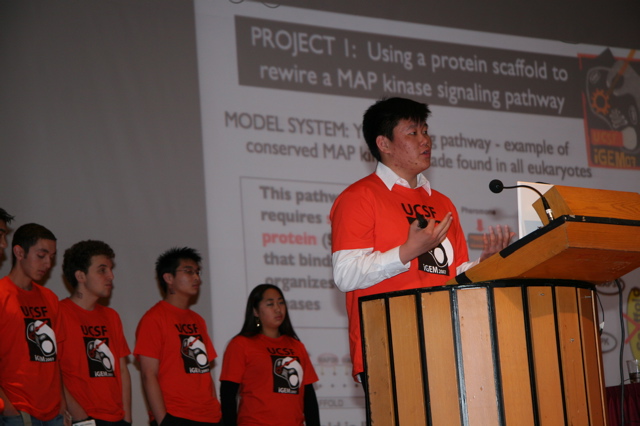
How do those crazy kids give congratulations these days? Uh... MAD PROPS? I don't know. Anyway, congratulations to San Francisco's Lincoln High School biotechnology team, who worked in a UCSF lab to create a synthesome (read the article which explains it, and the blog by a team member which gives the play-by-play). Their team went head-to-head with college kids from around the world, flirted with cute cell wranglers from China, made the list of finalists, and ate at Toscanini's. This coming-together of my SF life and my Cambridge life made me happy today; sure, team Lincoln/UCSF, Toscanini's is no Mitchell's, but there are some good flavors, and I wish I'd been there to congratulate you.

Lincoln High website

Friday, October 26, 2007

Dreams

Many large mammals seem to dream. Photo from www.tanzaniaparks.com

Earlier this week I dreamed that someone from my residency program--it wasn't anyone I know in real life--plunked down a piece of paper in front of me with a dollar amount. (About two month's pay.)

"We'll give you this much to buy you out of your contract," the person said. They didn't want me to be an intern anymore and were going to pay me to stop working for them.

In reality, I would never be confronted with that kind of choice; I'd be fired or I wouldn't. But the dream made the prospect of being fired even more dreadful: I had to choose to be fired, and take the money; or refuse to be fired but not get the money while knowing that my bosses wanted to fire me anyway. I realized this in the dream, and began thinking, "This is terrible--they're going to stop me from being a doctor, they don't think I can be a doctor, but I've worked so hard to be one, I want so badly to be one"; and then I woke up suddenly with a terrible feeling. I quickly realized that I'd been dreaming.

"I'm doing fine," I thought to myself, in the dark of early morning, Ms. Dr. Hemodynamics and the Hemodynamic Cat sleeping soundly in the bed as I woke up and looked around at the real world. "That's not what's happening." Or rather, it wasn't what was happening in my actual life, where my bosses do not seem displeased with me. But clearly some portion of it was happening in my emotional life, my submerged world of fears.

Later that week, I led a presentation about a particular case, designed to start a discussion among interns, residents, faculty and guest experts about how to think about a patient's problem, and the issues it brought up. I did some work I didn't absolutely have to do on the presentation, and I hope it showed. Anyway, two faculty members told me I'd done a good job.

In the most literal sense, I have never dreamed of such a thing. I have imagined it or hoped for it in the daytime, and I have experienced it before. But I don't remember ever waking up from a dream in which one of my bosses or my teachers had just told me I'd done a good job, even though that happens much more often than someone firing me. Maybe I have those kinds of dreams. Maybe I just don't wake up from them with that startled dread that makes me remember a dream. Or maybe fear requires more overnight processing than hope or optimism do.

Freud said dreams represent narratives of wish fulfillment. I don't buy it, or not exactly. I read The Interpretation of Dreams in a film class when I was seventeen, and in retrospect I think it may remain more important for filmmakers than it does for clinicians.

I don't think I want to be fired from my job, or bought out of my contract. And I'm not prepared to do the interpretive backflips Freud and his followers required to turn that common kind of dream into a narrative of some kind of unconscious wish. It's a dream about a fear, which in the organization of the mammalian brain has got to be at least as powerful as a wish. If the brain is going to spend a lot of processing power on learning, fear is probably a better way of organizing learning for survival than wishing.

I'm a person of my era, not Freud's, and in my simple-minded way of thinking about dreams, I think of dreams as the brain reprocessing the material of the day--the intellectual material and the emotional material too. Whether they are wishes or fears, they get processed.*

Maybe the common ancestor of people and chimps slept in a forest, dreaming about her fellow apes turning on her for stealing fruit she didn't steal, horrified as they advanced towards her, shocked by this unreasonable turn of events; then, I hope, waking to find herself among peaceful family members. Now my great ape brain dreams about my bosses telling me I'd better fire myself from my job. If my dream has its ancestral predecessor, both of us apes--the ancestor great-great-great-grandmother ape and me--would be dreaming ourselves a deep social lesson, processed and then wired through many redundant circuits, which says, "Don't anger the apes around you."

For me, at least since junior high school and probably before, countless dreams have reinforced variations on this theme. Whatever imagined events these dreams are processing, their emotions and narratives surely help me be a more or less polite and socially appropriate person during waking hours. And that kind of dream creates such a powerful dread on waking that it is hard not to imagine that its mechanism must be deep and ancestral, dating back to that great-grandmother ape dreaming many millennia ago.

***

For practically every patient I admit to the hospital, I put in an order for "vital signs per routine"--which means they get woken up at night and early in the morning. People in the hospital also get woken up by their roommates, or their roommates' televisions; or worst and often most disturbingly of all, by other patients, delirious, their hallucinations representing a waking state of dreaming, or a dreaming state of waking, screaming "HELP ME!" or "GET AWAY FROM ME!" or "DON'T TOUCH MY PENIS!" across the hall again and again.

Once in a while you meet someone who can sleep through it all even without a lot of sedative on board. With one recent patient like this, I came to think that he'd spent enough time in hospitals that he'd figured out how to sleep while in a hospital room, including what had clearly become a nearly instinctive ability to fend off medical interns in the morning and keep sleeping despite their questions, pokings, and proddings. (This is not an easy task.)

Alone among my patients, this man was likely having dreams, full dreams, rich dreams. Did they make him better? Did they help him figure things out? I'll never know. I just hope that if I appeared in his dreams, I was never one of the apes who was hurting him.

<<>>

*Considerably less simple-minded descriptions of this kind of processing can be found in this article in Science for those who have access to it through local or academic libraries.

Monday, October 8, 2007

Fear is the mindkiller, part 3


My slogan for internship: "I will not fear. Fear is the mindkiller"--from Dune. But there seems to be no getting around fear.

***

I've been feeling burdened lately. I had the day off on Monday, and I was at a grocery store in a wealthy neighborhood getting myself the best coffee in town. I was there because I felt that with everything I'd been through in the previous week, I deserved a treat.

A young mom wearing some outfit that a skinny person would wear to yoga (the pants were tight and stretchy, not loose and concealing) had run into someone she knew. "Oh, I'm a little stressed right now," she said. "The kids are starting sports, and they're in school now, so lots going on, it's been a little bit overwhelming."

I wanted to turn to her and say, "Are you f***ing kidding me? Seriously. You're at the gourmet store buying $20 a pound cheese and hanging out with your kids, and what you have to say for yourself is you're stressed?"

Then I reminded myself that maybe for her motherhood does count as 80+ hours a week doing a terrifyingly high-stakes job, and although I do have to say that taking kids to soccer practice and the gourmet cheese store doesn't sound THAT stressful, what do I know?

Anyway, I realized that my reaction to her was not about her. It was about my stress, and how annoyed I was that someone else would claim to be as stressed as I am. In other words, I'm starting to feel sorry for myself. It was inevitable that it would start sometime--self-pity is probably the one thing that almost all medical interns have in common at one point or another--and I now recognize that it has started.

But I have always been willing to work reasonably hard, and for long hours. And there are many things about the work that is interesting and challenging in all sorts of good ways. So it isn't the time or the work that makes me feel burdened and sorry for myself. It's the fear.

I have a low-grade fear that never really disappears, like watching a scary movie while the main characters are driving around doing something innocuous. You know something bad is going to happen, but you’re not sure what.

I make mistakes all the time. Most aren't a big deal, and the few mistakes that could have become more worrying were caught by other people. There are only one or two mistakes that can still haunt me. The worst one came very early on in internship, when I didn't recognize an acute problem as it was beginning, until it required more serious intervention than it might have if I'd recognized it earlier. No one blamed me for it. Like many intern mistakes, it was an error shared by several people. And the outcome of the patient's hospital course was unlikely to have been any different as a result.

When I came back to the incident a couple of days later in a check-in session with my attending of the time, he said, "This is why you do residency. You just have to see it often enough to recognize it. If medicine was all things you could learn in books, we could just turn you loose after medical school. You can go ahead and feel bad about it, and in fact, you should, so it won't happen again. But this is what residency is about." He said that I was right on track for where I should be in terms of my skills as a physician.

I guess I took his advice: I didn't let the mistake stop me from coming to work the next day. But remembering that morning can still clench my stomach with a special force. No matter how much I reassure myself or other people reassure me that such mistakes are part of the normal course of my development, mistakes still frighten me.

It's mostly just the most recent mistake or two I've made that I remember at any given time, though, because the main reason the more inconsequential mistakes matter is that they remind me of my potential to create harm. That clutching clenching weight inside my abdomen, the horror of the near-miss, returns even when I think about the smallest errors. It's not usually the errors themselves that make me feel that way; it's the fact that I continue to make errors.

For the first couple of months the excitement of being a doctor, and the new confidence I have as an intern that I didn’t have as a medical student, was enough to compensate for this sensation, enough to keep my energy and enthusiasm high. But recently I think that constant sense of near-miss or about-to-hit, that chronic fear, is starting to exhaust me a little bit.

I don’t want to get rid of the fear, because it makes me a better doctor as I make my lists and check them twice. But I want to figure out a way to live with the fear. I don't think it stops with internship. There are doctors I see who look totally relaxed, but they've been doctors for a long long time, and anyway, I'm not sure they should be as relaxed as they are. What's worse in a doctor than overconfidence?

In other words, fear is necessary. But it is also burdensome. More than the hours, more than the work itself, fear is what makes me feel like this is especially hard. Fear is what makes me feel secretly sorry for myself. Fear is what makes me tired and irritable; fear makes me hate some mom in a grocery store. My task for the year is not only to become a good doctor. It is learning how to live with the constant fear of being a bad doctor.

Musical break: Senegal Fast Food


Listening to Manu Chao's new album on this rainy day off from the hospital, I went to his website and found this song ("Senegal Fast Food") he did with Amadou & Mariam--not on the new album, which like this song is both infectious and addictive. The plot of the video sneaks up on you, especially if (like me) you only get 1/10 or 1/15th of the French.

Monday, September 24, 2007

How I'm changing... part 3


As internship was about to start, I was writing about how medical school had changed me; now internship is 25% done and I'm watching myself change in new ways. Back then I wrote wondering about whether I should aspire to having some kind of secular-spiritual version of love for all my patients. Now I feel like that's beside the point. One of my friends wrote back then that love like that might or might not be a good thing, but either way it's exhausting, and a different job than the one I already have to do.

She was right, as it turns out. The other day I was at work and was thinking, maybe there is still something to be said for the idea that I should love all my patients, but whether or not I should, I just can't, and don't. One of my co-interns says that in some way the definition of professionalism is acting like you care about people that you don't necessarily care about. That might be a little harsh--there is still something about human decency and compassion that I'd like to think exceeds simple professionalism. But right now, it's too much work to love everyone and also get all their discharge paperwork done and lab tests ordered; human decency has to be enough.

I do love some of my patients because they are sweet, or thoughtful, or charismatic in some way. And some of them are so totally insufferable as to become comic and therefore lovable in their own way.

But these days, what moves me through the day is not love. It's something much simpler: I move through the day because I need to get to the end of the day.

Saturday, September 1, 2007

Take it to the limits, one more time...


I page the infectious disease fellow, who's staffing the antibiotic approval pager. I know him: he was a resident when I was a medical student. He calls me back. I tell him briefly about the patient, and say, "We want IV vancomycin."

"When you were in medical school," he says, joking with me but also not, "You were this cool progressive socialist guy, ready to fight the system. Now you're calling me with this. So, I'll approve it, even though it's a NIMBY thing that will increase antibiotic resistance for other people. But what happened to you? What happened to the idealism?" He's making fun of me a little, but also I think wondering about the actual answer to the question.

"If I thought about health policy for more than a minute of my day," I tell him, "I couldn't get anything done."

I once heard an ICU nurse, frustrated with the night's project of keeping some very old and utterly unconscious person alive with expensive equipment and unclear benefit other than satisfying the person's relatives that "everything is being done", and she blurted out, "This is insane. We should be taking this money and investing it in children." Fair point. But either she ignores that point of view for most of her day or she's going to have to get a new nursing job.

I send people to MRIs all the time; as one attending of mine said, Boston probably has more MRI machines than all of Ontario. The availability of MRIs drives our willingness to order new studies; if it was harder to get someone into an MRI, we'd accept the slightly less exact findings of a CT, and so on.

Obviously from a policy point of view this suggests we should probably send less people to MRIs. But as an intern, my job is to carry out the medical plan, and to suggest aspects of that plan. I don't have the final authority over that plan. It is usually not for me to decide if someone gets an MRI or doesn't, at least not on a policy basis. It might not even be for the attending to decide: if other people in the area usually get MRIs for a particular problem, it begins to become negligence if the attending doesn't get their own patients the MRI.

Either way, I order IV vancomycin and MRIs all the time, among many other things, much of it on the federal government's Medicare tab, while the president says the federal government shouldn't get more involved in making sure children have health insurance. It's not like this cost comes out of nowhere; when healthcare dollars go to MRIs, there's somewhere else they're not going. When we use broad spectrum antibiotics to "cover" someone with a fever we can't yet diagnose, it costs money and increases bacterial resistance.

But if I'm honest, it's not just the system that demands this of me. My own views are full of contradictions: when facing an individual I am ready to go all out, to order everything that might have some benefit.

When thinking about the society, I think that there should probably be some limit to this. But I'm not the one who makes the limits. More often, as an intern in a large teaching hospital, I push the limits.

I say something about this to the ID fellow, and say that even if I had any power at this point, I'm not sure what I would do about this contradiction of wanting limits and abhorring them. We're quiet for a second.

Then I say, "Anyway, we want our IV vancomycin."

"Another resistant organism being created, at exorbitant cost," he says.

"Yep," I say. "Still, we want it."

"Done," he says, clearing it off the approval queue on his computer screen.

Sunday, August 26, 2007

Finishing BMT.


photo: leukemia cells. From PLOS Biology.

I'm now finished with the bone marrow transplant service--or what is really the hematologic malignancy service, which serves people with lymphoma, leukemia or other problems of their blood and immune cells. It was a tough month, with long hours, as my lack of posting at this blog will reveal.

One snapshot:

The floor below is a labor and delivery floor. On the elevator up, a family of kids and adults is talking excitedly, carrying a congratulatory balloon. One woman stands quietly on the side; the oncology/bone marrow transplant floor button is already pushed when I get on. The family leaves at the labor and delivery floor, and the door closes, leaving her and me in the elevator. She says, "It's amazing how different those two floors of the hospital are." We get off at the next floor; it is quiet.

A sign at the entrance to the BMT wing tells visitors that children under 6 are not allowed. Small children and their microbes are among the many things which pose potentially mortal danger to people getting bone marrow transplants. They are sitting in their rooms, waiting for their new immune systems to grow.